It's "Data 360" Now, Not "Data Cloud," and the Rename Tells You Exactly Where Salesforce AI Is Headed
TL;DR: Salesforce renamed Data Cloud to Data 360 to signal that your data layer is no longer back-office plumbing. It's the product that makes AI agents trustworthy. If your team or your agency still says "Data Cloud," you're a release behind, and the gap shows up as agents that sound confident and get things wrong.
If your last vendor email, your admin, or your agency still says "Data Cloud," stop and notice it. That's not a vocabulary slip. It's a tell. Data Cloud renamed Data 360 isn't Salesforce reshuffling deck chairs. It's the company moving the data layer from the basement to the storefront, on purpose, because an AI agent is only as trustworthy as the data underneath it.
I've spent 13+ years cleaning up Salesforce orgs, and I've watched this one product get renamed five times. Most rebrands are noise. This one is a roadmap. Here's how to read it.
The name lineage no quick AI summary can fake
Here's the part a 10-second AI summary will get wrong, because you have to have lived through the upgrades to know the order. This is the same product, renamed each time its job description got bigger:
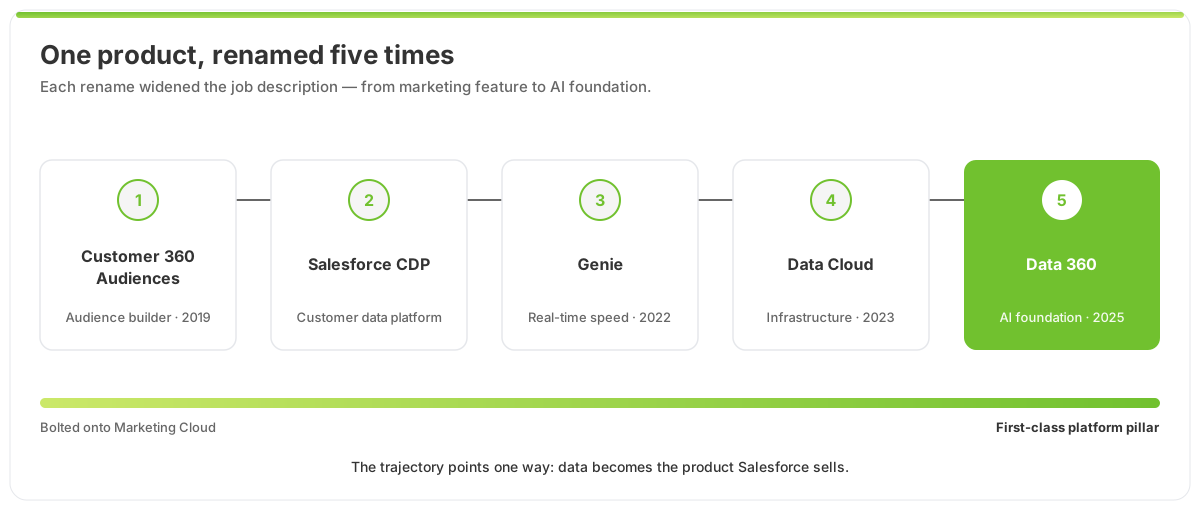 The same product, renamed five times: each rename promoting the data layer from marketing feature to AI foundation.
Read the names as one sentence and the strategy reads itself:
- Customer 360 Audiences: "We help you build marketing segments." A glorified audience-builder bolted onto Marketing Cloud.
- Salesforce CDP: "We're a customer data platform now." Joining a category martech buyers already understood.
- Genie: "We do this in real time." The 2022 rebrand was about speed and streaming ingestion.
- Data Cloud: "This is infrastructure." It graduated from a marketing feature to a platform layer underneath everything.
- Data 360: "This is the product." Same family name as Customer 360, promoted to a first-class pillar, not a feeder system.
Each name is a wider job description. The trajectory only points one way: data stops being a thing you feed Salesforce and becomes the thing Salesforce sells.
Why did Salesforce rename Data Cloud to Data 360?
Because Agentforce forced their hand: an AI agent is only as trustworthy as the data feeding it, so Salesforce promoted the data layer from back-office plumbing to a first-class product.
Here's the reframe. Salesforce didn't promote "data" to a headline pillar because it tested well in a focus group. They did it because Agentforce forced their hand. An AI agent is a confidence machine. It answers in the same calm, authoritative tone whether the data behind it is right or garbage. The only thing standing between "helpful agent" and "confidently wrong agent" is the data layer feeding it.
So Salesforce renamed the plumbing to match its new, terrifying importance. "Data Cloud" sounded like storage. "Data 360" sounds like the unified, grounded, agent-ready source of truth. That's the bet the entire AI roadmap now rests on. The rename is Salesforce admitting, out loud, that the data layer is where AI projects live or die.
If you want the unglamorous version of why this matters, we wrote it plainly: your AI agent is going to fail, and it won't be the AI's fault. Data 360 is Salesforce putting that same warning on the price list.
What actually changed when Data Cloud became Data 360?
Mostly the positioning changed, not the engineering reality in your org. The duplicates, dead fields, and conflicting definitions are exactly where you left them.
Let me be the vendor-neutral voice here: a lot of this is positioning. But positioning tells you where the money and the roadmap are going, which is exactly what a buyer should track.
| "Data Cloud" framing | "Data 360" framing | |
|---|---|---|
| What it implied | Optional add-on, storage layer | Core pillar, the AI foundation |
| Who it was sold to | Marketing / data teams | Anyone deploying agents |
| Strategic role | Unify data for analytics | Ground agents so they don't lie |
| What it signals to you | "Nice to have someday" | "Required before agents are safe" |
What didn't change: the engineering reality in your org. Renaming the product does nothing for the 300 dead fields, the four versions of "account status," and the duplicate contacts that will quietly poison any agent you point at them. According to Gartner, poor data quality costs the average organization roughly $12.9 million a year . Data 360 is the bucket. It doesn't clean the water.
This is the trap I watch SMBs fall into: they hear "Data 360 makes agents trustworthy," buy the SKU, point it at an unaudited org, and end up with an agent that's more convincing while being just as wrong. The rename raises the stakes on a problem most orgs haven't fixed. As we argued in Headless 360 won't save your business: it will expose every mess you've been ignoring, a better data layer is a brighter spotlight on existing chaos, not a cure for it.
What should a 10-to-500-person company actually do about the rename?
You don't need to memorize the rebrand history. You need three moves:
- Update your vocabulary, and judge your vendors by theirs. If a partner is still pitching you "Data Cloud" in 2026, ask when they last shipped a project. Current language is a cheap, honest signal of whether they're keeping up.
- Audit before you ingest. Data 360 will faithfully unify whatever you give it, mess included. Run a real data-readiness pass first. That's the entire point of our data readiness audit. It decides whether your agent helps customers or confidently misinforms them.
- Don't pay to copy data you don't have to. "Unified" doesn't always mean "duplicated." Zero-copy federation can save real money, and sometimes it quietly doesn't. Know which case you're in before you sign. We did the math in when zero-copy saves real money.
✅ Key Takeaways
- Data Cloud renamed Data 360 is a strategy signal: the data layer is now a first-class product because agents are only as trustworthy as the data under them.
- The name lineage (Customer 360 Audiences → CDP → Genie → Data Cloud → Data 360) shows data steadily promoted from feature to foundation.
- The rename raises the stakes on your data quality. It does not fix it.
- Audit your org before you ingest, or you'll just build a more convincing wrong answer.
- If your agency still says "Data Cloud," treat it as a freshness check on their whole practice.
Frequently Asked Questions
Is Data 360 a new product, or just Data Cloud renamed?
It's the same product family, renamed. Salesforce rebranded Data Cloud to Data 360 to position it as a core platform pillar alongside Sales Cloud and Customer 360, not a marketing add-on. The capabilities evolved gradually over years; the name change is the strategic signal that the data layer is now central to the AI roadmap.
Do I need Data 360 to use Agentforce?
Not strictly to switch it on, but you need grounded, unified data for agents to be reliable, and Data 360 is Salesforce's primary tool for that. The deeper requirement isn't the SKU; it's data readiness. A small org can prove value with a focused pilot before committing to a large consumption spend.
Why does Salesforce keep renaming this product?
Because its job keeps expanding. It started as an audience-builder for marketing, became a CDP, gained real-time speed as Genie, became infrastructure as Data Cloud, and is now a headline AI foundation as Data 360. Each rename matches a wider role. Tracking the lineage tells you where Salesforce is putting its money.
Will Data 360 fix my messy Salesforce data?
No. Data 360 unifies and activates whatever you give it, including duplicates, dead fields, and conflicting definitions. It makes bad data more accessible to agents, which can make wrong answers more convincing. Clean and audit first, then ingest. The rename raises the stakes on data quality; it doesn't resolve it.
Is the rename worth paying attention to if I'm not buying AI yet?
Yes. The rename tells you where Salesforce is steering its entire platform, and your renewal will follow that direction whether or not you opt into agents this year. Getting your data layer clean now is the cheapest, lowest-risk work you can do, and it pays off regardless of when you turn agents on.
Take the rename as your cue to get audit-ready
Here's the honest read from someone who's watched this product change names five times: Salesforce just told you, in branding, that your data layer is the thing standing between a useful agent and a liability. The companies that win the next 18 months won't be the ones who bought Data 360 fastest. They'll be the ones whose data was actually ready for it.
That's the work we do before anyone spends a dollar on agents. Start with a free, no-pitch Salesforce data audit. We'll tell you whether your org is genuinely agent-ready or one ingestion away from confidently misinforming your customers. If the audit surfaces real cleanup, our fixed-price Growth package gets your data layer ready to scale without the bloated, open-ended implementation you're rightly afraid of. Want the number before you commit? Run it through our ROI calculator.
Update your vocabulary. Then make sure the data underneath it can back up the new name.
Scott Ohlund, Founder & Chief Salesforce Architect, ODS

About the Author
Scott Ohlund
Certified Salesforce Architect with 13+ years of experience. Specialist in AI Agentforce, Data Cloud, and business automation solutions. As founder of Optimum Data Solutions, Scott helps SMB and mid-market teams cut Salesforce tech debt and ship AI-first CRM that actually moves revenue.
Ready to Transform Your Salesforce Experience?
Let's discuss your specific needs and create a customized solution that drives real results for your business.