The Data Readiness Audit: The Engagement That Decides Whether Your AI Helps Customers or Confidently Misinforms Them
TL;DR: A Salesforce data readiness audit is a scoped, fixed-price project that inspects your data (dedupe, identity resolution, data-model fit, unstructured-content inventory, and credit-burn risk) before you build an AI agent. Skip it and your agent won't fail loudly. It will answer customers fast, sound confident, and be wrong.
Here's the failure nobody demos for you. You buy Agentforce. You wire it to your CRM, your support inbox, and your ERP. The demo dazzles. Then a real customer asks a real question, and the agent answers (fast, polite, and flat wrong) because it pulled from one of the three contradictory records you keep for that customer and had no way to know which was true.
That is not an AI problem. That is a Salesforce data readiness audit problem you never ran, and it's the single most common reason AI agent projects quietly underdeliver. The most dangerous data in your org isn't the data that's missing. It's data that's connected but not unified: wired together but never reconciled into one version of the truth.
This post is the playbook I run before anyone on my team writes a line of agent logic. I call it the Data Readiness Audit. It's the gateway engagement: fixed scope, fixed price, and a hard go/no-go at the end.
The reframe: connected is not the same as unified
Most teams hear "AI-ready" and picture "the data is plugged in." Integration sells that story hard. Zero-copy federation, MuleSoft, native connectors: they all make data reachable. Not one of them makes it correct.
An LLM does not reason about which of your three "Acme Corp" accounts is the real one. It retrieves, it pattern-matches, and it speaks with total confidence. Feed it conflicting inputs and it will pick one and defend it like a closing argument. The polish of the language hides the rot in the data underneath.
So the question a data readiness audit answers isn't "can the agent see the data?" It's "when the agent sees the data, will it land on one unambiguous answer?" If the honest answer is no, you're not building an agent yet. You're building a liability with a friendly voice. (This is the same trap I unpack in why AI agent projects fail on data readiness. The AI is the one component that deserves the blame least.)
What are the five steps of a Salesforce data readiness audit?
The five passes are dedupe, identity resolution, data-model review, an unstructured-content inventory, and a credit-burn check. Run them in that exact order.
A real audit is repeatable, not a vibe check. Here are the five passes I run, in order, and what each one is actually protecting you from.
| Step | What we inspect | The risk it kills |
|---|---|---|
| 1. Dedupe | Duplicate Accounts, Contacts, Leads | The agent cites a stale duplicate as fact |
| 2. Identity resolution | Matching the same entity across systems | "Three Acme Corps" collapse into one golden record |
| 3. Data-model review | Object structure, relationships, field hygiene | Agent can't traverse a broken model |
| 4. Unstructured-content inventory | PDFs, SOWs, notes, support threads | Grounding source is missing or junk |
| 5. Credit-burn check | Query patterns, retrieval scope, token cost | Surprise consumption bill at month's end |
Step 1: Dedupe, the cheapest credibility you'll ever buy
Duplicates are where confident misinformation starts. Two Contact records for the same buyer (one with last quarter's title, one with this quarter's) and the agent has a coin-flip's odds of being current. Salesforce has long reported that organizations commonly carry duplicate rates in the double digits across Leads and Contacts . Before any AI touches the org, we measure the real rate and collapse the dupes with surviving-record rules you approve.
Step 2: Identity resolution, the step everyone skips
This is the pass that separates a real audit from a cleanup. Dedupe fixes duplicates inside one object. Identity resolution answers a harder question: is the "Acme" in your CRM, the "Acme Corporation" in your billing system, and the "ACME Corp." in your support tool the same company? Until you can resolve that into a single entity, your agent is reasoning across a fractured identity. This is exactly the work Data 360 was built to do, and exactly the work people assume happens automatically. It doesn't.
Step 3: Data-model review, can the agent actually navigate?
An agent reasons over relationships. If your model is a swamp of dead fields, orphaned objects, and bolted-on workarounds, the agent inherits every wrong turn. We map the objects the agent needs, trace the relationships, and flag the field graveyard: the hundreds of dead fields quietly degrading every query. Over-customized orgs are the worst offenders, which is why over-customization is the technical debt that sinks AI projects.
Step 4: Unstructured-content inventory, your real moat
Your structured CRM data is table stakes. Your unstructured content (proposals, SOWs, support notes, call summaries) is the moat a generic model can't replicate, but only if it's findable and trustworthy. We inventory what exists, where it lives, and what's safe to ground an agent on. (More on why your unstructured data is the moat ChatGPT can't copy.)
Step 5: Credit-burn check, the bill nobody scoped
Every retrieval costs something. A sloppy grounding scope that pulls 40 documents per query instead of 4 doesn't just slow the agent. It multiplies your consumption spend. We model the query patterns and estimate credit burn before you sign a commitment, so the Agentforce pricing model holds no surprises at month's end.
How does the audit gate the agent build?
The audit ends in a hard go/no-go: green-light the build when the data is a unified single source of truth, route to a dedupe-and-resolve remediation sprint when it isn't, or stop the project if the data still fails the readiness bar.
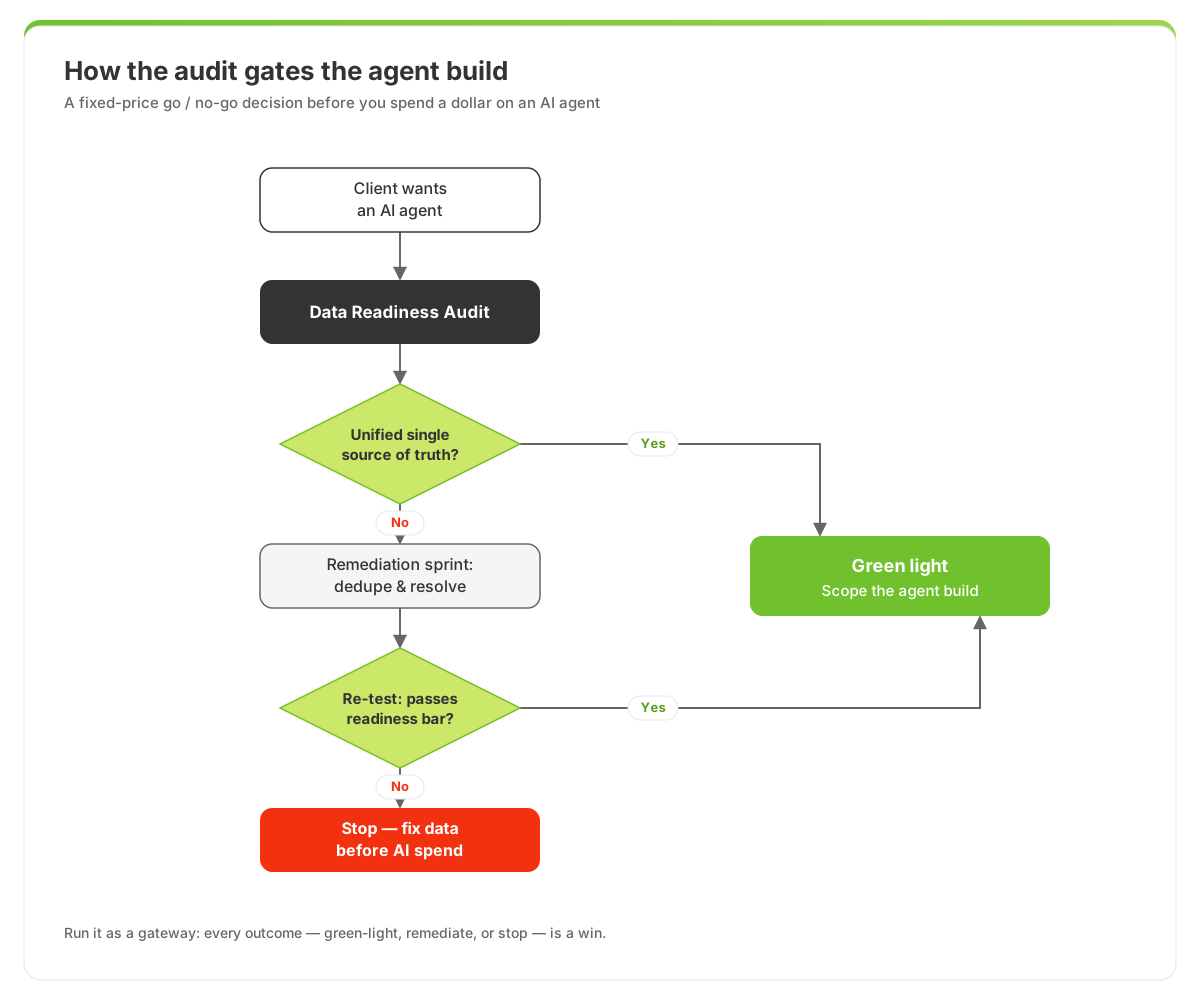 The audit is a gateway with a hard go/no-go: green-light, remediate, or stop.
The entire point of running this as a gateway is the diamond in the middle. You get an honest go/no-go before the expensive part starts, not three months and six figures into an agent that hallucinates account status to a paying customer.
What does it cost to skip the data readiness audit?
Skipping it costs you a full agent rebuild plus the reputational hit of an agent that told a paying customer the wrong thing with a straight face.
Let's do the math an exec actually cares about. The figures below are illustrative ranges, not a quote .
| Path | Up-front spend | What you actually get |
|---|---|---|
| Skip the audit, build the agent | $0 saved now | Agent ships, misinforms customers, trust erodes, full rebuild later |
| Run the audit first | Fixed-price gateway engagement | Go/no-go clarity, clean foundation, an agent people trust |
| Audit + remediation | Audit + scoped sprint | Unified data, predictable credit burn, faster agent build |
The audit isn't an extra cost. It's the line item that prevents the real cost: a rebuild plus the reputational hit of an agent that told a customer the wrong thing with a straight face. For the underlying business case in CFO language, see funding tech-debt remediation as an ROI project.
✅ Key Takeaways
- Connected is not unified. Integration makes data reachable; only reconciliation makes it correct. AI exposes the difference instantly and publicly.
- Identity resolution is the step everyone skips, and the one that decides whether "three Acme Corps" become one trustworthy answer.
- The five passes are dedupe, identity resolution, data-model review, unstructured-content inventory, and credit-burn check. In that order.
- Run it as a gateway with a go/no-go. A flagged "not ready" before the build is far cheaper than a confident wrong answer after launch.
- The audit's output is a decision, not a deliverable. Green-light, remediate, or stop. All three are wins.
Frequently Asked Questions
What is a Salesforce data readiness audit?
It's a scoped, fixed-price engagement that evaluates whether your data can safely ground an AI agent. It runs five passes: deduplication, identity resolution, data-model review, an unstructured-content inventory, and a credit-burn check. Then it ends with a clear go/no-go. The deliverable isn't cleanup; it's a decision about whether you're ready to build.
Why can't I just connect my data and let the AI sort it out?
Because AI doesn't sort. It retrieves and asserts. Given two contradictory records, an LLM picks one and answers confidently, with no signal that it guessed. Connecting data makes it reachable, not reconciled. Without identity resolution and dedupe first, you've handed a confident system permission to spread your worst data faster.
How long does the audit take and what does it cost?
For most SMB and mid-market orgs, the audit itself is a short, fixed-price engagement measured in days, not months . It maps cleanly to our packages; remediation, if needed, is scoped separately so you approve the spend with eyes open instead of discovering it mid-build.
What's the difference between dedupe and identity resolution?
Dedupe removes duplicate records within one object: two Contacts for the same person. Identity resolution matches the same entity across systems: the account in your CRM, billing tool, and support platform that are all the same company. You need both. Dedupe alone still leaves your agent reasoning over a fractured cross-system identity.
Do I need this if I'm only piloting Agentforce, not committing?
Yes, arguably more so. A pilot built on unready data "succeeds" in the demo and fails in production, teaching you exactly the wrong lesson. Pair the audit with a low-cost Agentforce pilot so you're testing the agent against clean data, not your data's worst day.
CTA: Find out if your data tells the truth, before your AI does
You don't need another agent demo. You need to know whether your data will make that agent trustworthy or dangerous. A weekend of guessing won't answer that. A structured audit will.
Start with a free Salesforce audit and I'll show you where your "connected" data is quietly un-unified. If we surface the typical mess, our Emergency package ($4,997) is built to fix what's broken fast. If you're scaling toward a real Agentforce build, the Growth and Transformation packages fold the readiness audit in as the mandatory first gate. Want the numbers first? Run your scenario through the ROI calculator, then book a conversation. Every engagement carries our 30-day milestone guarantee, because the foundation either holds or it doesn't, and you deserve to know which before you build on it.

About the Author
Scott Ohlund
Certified Salesforce Architect with 13+ years of experience. Specialist in AI Agentforce, Data Cloud, and business automation solutions. As founder of Optimum Data Solutions, Scott helps SMB and mid-market teams cut Salesforce tech debt and ship AI-first CRM that actually moves revenue.
Ready to Transform Your Salesforce Experience?
Let's discuss your specific needs and create a customized solution that drives real results for your business.