Headless 360 Won't Save Your Business: It Will Expose Every Mess You've Been Ignoring
TL;DR: Salesforce Headless 360 for SMB makes your entire org callable by AI agents and outside systems. It does not clean your data. It amplifies whatever state you're already in. Duplicate records, sloppy permission sets, and dead fields stop being quiet annoyances and become live error and security surfaces. Fix the org first. Go headless second.
Here's the part nobody selling you "composable Salesforce" wants to say out loud: going headless doesn't improve your org. It exposes it.
For years your duplicate contacts, your 14 overlapping permission sets, and your three fields that all sort of mean "account status" have been a private embarrassment. Annoying, but contained. Humans worked around them. A rep eyeballed two "Acme Corp" records and picked the right one. An admin quietly knew Status__c was real and Account_Status__c was dead.
Salesforce Headless 360 for SMB removes the human in the middle. Now an agent picks. An external app reads. An API resolves "Acme Corp" and grabs the wrong one, at machine speed, with no instinct to pause. The mess didn't grow. The blast radius did.
What does going headless actually change about your Salesforce risk?
Headless 360 turns Salesforce from a destination your team logs into (and stops paying for seats nobody uses) into an orchestration engine that other systems and agents call directly. Data 360, APIs, and Agentforce all reach into the same underlying records and metadata.
That's genuinely powerful. It's also why I tell every SMB the same thing: headless is a force multiplier on whatever state your org is already in. Good org, multiplied. Messy org, multiplied. There is no neutral setting.
Watch what changes the moment your records become programmatically callable:
| Org problem | Cost when humans are the interface | Cost once it's headless |
|---|---|---|
| Duplicate accounts/contacts | A rep burns 30 seconds picking the right one | An agent confidently updates the wrong record; the API hands the wrong one to a partner system |
| 12+ overlapping permission sets | Confusing admin, occasional over-access | Every integration user inherits the union of that mess, a live security surface |
| Three fields meaning "status" | Reporting is annoying | Agents read the dead field and act on stale data |
| 300 dead fields in the field graveyard | Cluttered page layouts | Ambiguous schema the agent has to guess its way through |
None of these are new problems. Headless just relocates them from "internal friction" to "external, automated, customer-facing risk."
Is the Einstein Trust Layer a separate AI safety system?
No. At its core it just enforces the Salesforce permission model you already configured.
Here's the reframe that should change how cautious buyers think about this.
When vendors talk about the Einstein Trust Layer, it sounds like a new, separate safety system you're buying, a magic guardrail bolted on top of the AI. It isn't. At its core, the trust layer enforces your existing Salesforce permission model. When an agent acts, it acts as a user: that user's profile, permission sets, sharing rules, and field-level security.
Read that twice, because it's the whole ballgame: the AI's "guardrails" are the permissions you already set up. If your permission sets are a tangle, your trust layer is a tangle. There is no separate, smarter security layer riding in to save you. The robot inherits your access decisions, all of them, including the sloppy ones you forgot you made.
So "securing your AI agents" turns out to be the deeply unglamorous work you've been deferring: consolidate permission sets, kill orphaned access, lock down field-level security. The upside? That's not buying ambition. That's right-sizing architecture to your actual complexity, exactly where SMBs should live.
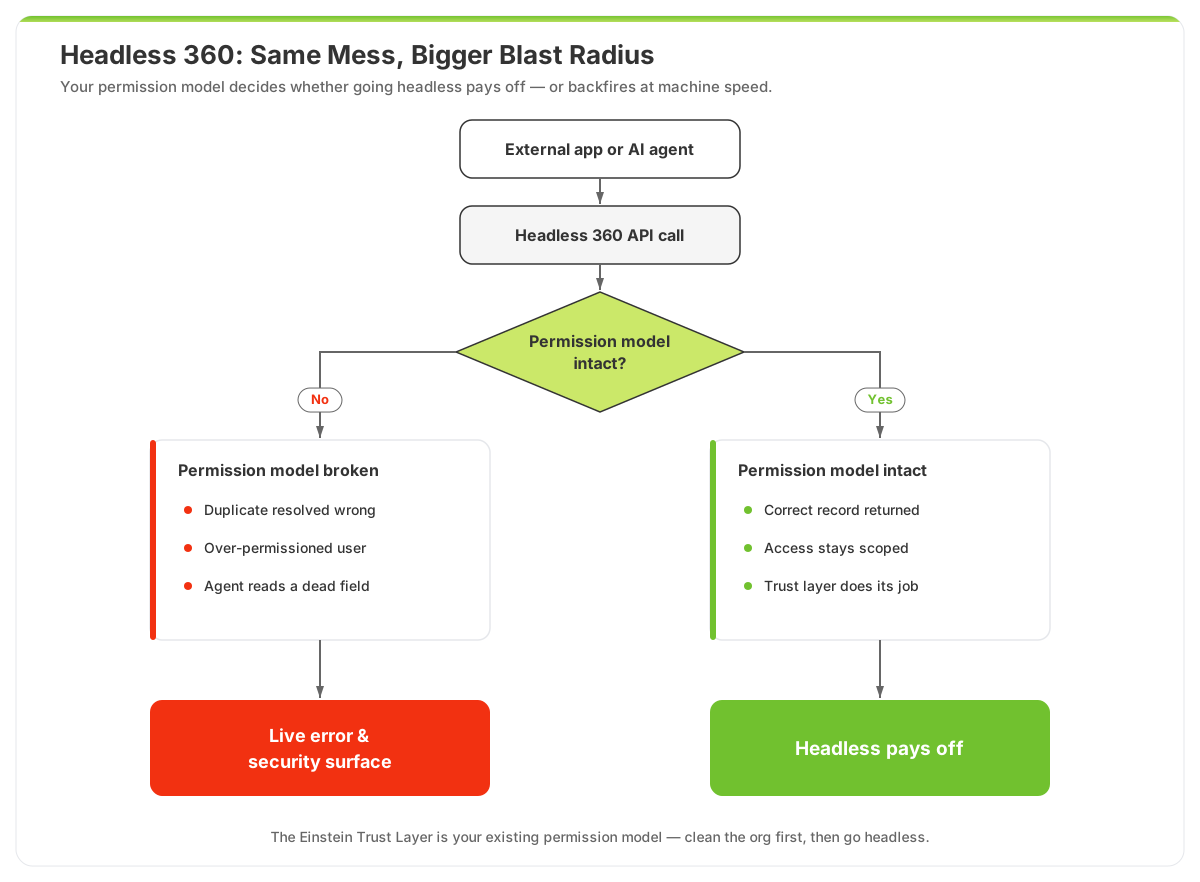 An API call is only as safe as your permission model: intact returns the right record, broken multiplies the mess.
Composable regret: the trap I watch SMBs walk into
I call the next stage composable regret. It plays out like clockwork. A 60-person company gets sold a full headless, agent-everywhere vision. They wire up the APIs, stand up an agent, and demo it. Dazzling for a week. Then the agent updates the wrong "Acme Corp," a partner integration pulls a stale status, and a forgotten permission set grants an integration user read access to comp data.
Now they're not modernizing. They're firefighting, in production, in front of customers. Ambition outran readiness, and the gap showed up as incidents.
Same root cause behind why most AI agent projects fail on data readiness, not on the AI. The model is fine. The plumbing it's standing on isn't. Salesforce reports strong AI resolution rates in controlled conditions, and those numbers are real. They're just measured on clean, well-grounded data you don't have yet.
The contrarian truth: the right move before headless is almost always boring. Deduplicate. Consolidate permission sets. Retire dead fields. Collapse the three "status" fields into one. It's not a moonshot. It's hygiene. And it's the single highest-ROI thing you can do before you let agents and APIs loose on your org.
How big does your Salesforce architecture really need to be?
A 50-person company does not need an enterprise composable stack. It needs an org clean enough that, when you do make it callable, the calls return the right answer. Headless 360 for a 50-person company looks nothing like the enterprise version. Pretending otherwise is how you buy six figures of regret.
The sequencing that actually works:
- Audit the mess. Quantify duplicates, permission sprawl, and dead fields. → verify: you have a real count, not a vibe.
- Remediate. Dedupe, consolidate permissions, retire fields, standardize schema. → verify: one source of truth per concept; least-privilege access.
- Then expose. Turn on the APIs and agents against an org that won't betray you. → verify: an agent action returns the correct record under a scoped permission set.
Skip step 2 and headless doesn't fail loudly on day one. It fails quietly, then expensively.
✅ Key Takeaways
- Headless 360 amplifies your org's current state. It never neutralizes it.
- The Einstein Trust Layer is your existing permission model. Sloppy permissions equal sloppy AI guardrails. There's no separate safety net coming.
- Duplicates, permission sprawl, and dead fields move from internal friction to live, customer-facing error and security surfaces.
- Avoid composable regret: match architecture to complexity, not ambition. For most SMBs, that means cleanup before exposure.
- The highest-ROI pre-headless work is unglamorous data hygiene, and it pays for itself the moment agents go live.
Frequently Asked Questions
Does Headless 360 fix my messy Salesforce data?
No. That's the most expensive misconception in the room. Headless 360 makes your org callable by APIs and AI agents; it does nothing to clean the underlying records. If anything, it raises the stakes on existing problems by removing the human who used to silently work around them. Clean the data first, then expose it.
Isn't the Einstein Trust Layer enough to keep AI agents safe?
The Einstein Trust Layer enforces your existing Salesforce permission model (profiles, permission sets, sharing rules, field-level security) plus data masking and audit. It's real protection, but only as good as the permissions you've configured. If your permission sets are a mess, your "AI guardrails" inherit that mess. Securing agents means cleaning permissions, not buying a new layer.
What should an SMB do before going headless?
Three things, in order: deduplicate accounts and contacts, consolidate overlapping permission sets toward least-privilege, and retire dead or duplicate fields so each business concept has one source of truth. A focused data readiness audit quantifies all three, so you fix the right things instead of guessing.
How do I know if my org is ready for agents and APIs?
Run a readiness check before you spend on architecture. Score your data quality, permission hygiene, and schema consistency. Our Agentforce Readiness Scorecard maps you from "CRM mess" to "agent-ready" so you can see the gap honestly (and the cost of closing it) before you commit to a headless build.
Is going headless worth it for a company my size?
Often yes, but only after cleanup, and only scoped to your actual complexity. Match architecture to complexity, not ambition. A clean, modestly-headless org that returns correct answers beats an over-engineered composable stack standing on bad data every time. The ROI lives in the sequencing.
CTA: Find the mess before headless does
Headless 360 will eventually shine a floodlight on your org. The only question is whether you find the duplicates, the permission sprawl, and the dead fields first (quietly, on your terms) or whether an agent finds them for you, in production, in front of a customer.
Don't fly blind into composable regret. Start with a free Salesforce audit: we'll quantify your duplicates, map your permission-set sprawl, and surface the schema ambiguity that would trip up any agent or API you point at it. If the audit shows real exposure, our fixed-price Growth package ($14,997) handles the cleanup-and-right-size work that makes headless safe, backed by a 30-day milestone guarantee, so you see progress before you're all-in. Want the business case first? Run the numbers on the ROI calculator or talk it through with us directly.
Clean the org. Then go headless. In that order. Every time.
Scott Ohlund, Founder & Chief Salesforce Architect, ODS

About the Author
Scott Ohlund
Certified Salesforce Architect with 13+ years of experience. Specialist in AI Agentforce, Data Cloud, and business automation solutions. As founder of Optimum Data Solutions, Scott helps SMB and mid-market teams cut Salesforce tech debt and ship AI-first CRM that actually moves revenue.
Ready to Transform Your Salesforce Experience?
Let's discuss your specific needs and create a customized solution that drives real results for your business.