The Agentforce Readiness Scorecard: 5 Levels From "CRM Mess" to "Agent-Ready"
TL;DR: An Agentforce readiness assessment scores the four things agents depend on (data unification, identity resolution, knowledge-base hygiene, and your permission model) across five levels, from "CRM Mess" to "Agent-Ready." Most companies sit at Level 2. Agents start working reliably at Level 3. The license is the easy part.
Most teams ask the wrong question about Agentforce. They ask, "Should we buy it?" The right question (the one a real Agentforce readiness assessment answers) is, "Are we at Level 3 yet?"
Here's the reframe that should change the entire conversation: Agentforce doesn't fail because the AI is bad. It fails because it faithfully reports the mess underneath it. An agent is a mirror with a microphone. Point it at four disconnected systems, duplicate accounts, a knowledge base last cleaned in 2023, and a permission model nobody can explain, and it will confidently tell your customer something wrong. Fast. At scale. In your brand voice.
So before you sign a consumption commit, you need a score. Not a vibe. A score.
Why does a maturity model beat the "should we buy it" debate?
Because it converts an emotional yes/no fight into a measurable question with an owner, a checklist, and a deadline: something a CFO can actually fund.
The buy/don't-buy debate is unwinnable because it's binary and emotional. One exec saw a demo and wants it yesterday. Another got burned by a chatbot in 2019 and wants nothing to do with it. Both are arguing about the wrong variable.
A maturity model turns that fight into a measurement. Instead of "is Agentforce good," the question becomes "what level are we at, and what's the next concrete thing that moves us up one rung?" That's a question with a checklist, an owner, and a deadline, which is to say, a project a CFO can actually fund.
This is the same reason AI agent projects fail on data readiness, not model quality. The model is a commodity. Your readiness is the differentiator.
What four dimensions does an agent actually grade you on?
Forget feature lists. An agent only ever needs four things to give a safe, useful answer:
- Data unification: Can it see the whole customer in one place, or just one silo? Orders in one system, tickets in another, the contract in a third.
- Identity resolution: Does it know that "Bob Smith," "Robert Smith," and "bsmith@acme.com" are one person? Or will it stitch two customers into one hallucinated answer?
- Knowledge-base hygiene: Is the content it's grounded on current, de-duplicated, and authoritative? Or are there three versions of the return policy and no flag for which one is live?
- Permission model: Is what the agent can read and do scoped, governed, and auditable? Or could it surface a record (or fire an action) it should never touch?
Every Agentforce horror story traces back to one of these four. That's the whole grading rubric.
The Agentforce Readiness Scorecard: 5 levels
| Level | Name | What it looks like | Can an agent succeed? |
|---|---|---|---|
| 1 | CRM Mess | Data in silos, rampant duplicates, no single source of truth, knowledge living in people's heads. | No. It will hallucinate. |
| 2 | Organized but Siloed | Clean-ish CRM, but data lives in 3–5 systems that don't talk. Most companies are here. | Only for trivial, single-system FAQs. |
| 3 | Unified Core | Key data unified (often via Data 360), identity resolved for top objects, one current knowledge base. | Yes. A narrow, scoped agent works reliably. |
| 4 | Governed & Grounded | Add: documented permission model, Einstein Trust Layer configured, audit trail, human-in-the-loop on actions. | Yes, for customer-facing and action-taking use cases. |
| 5 | Agent-Ready | Unified, resolved, governed, and monitored. Knowledge auto-refreshes; permissions reviewed; metrics tracked. | Yes, at scale, with confidence. |
The threshold that matters is the jump from Level 2 to Level 3. That's where an agent stops being a liability and starts being an asset. According to Gartner, the majority of enterprise AI projects stall before delivering value , and in my experience nearly all of those stalls are a Level-2 org trying to run a Level-3 use case.
Where an agent breaks, gate by gate
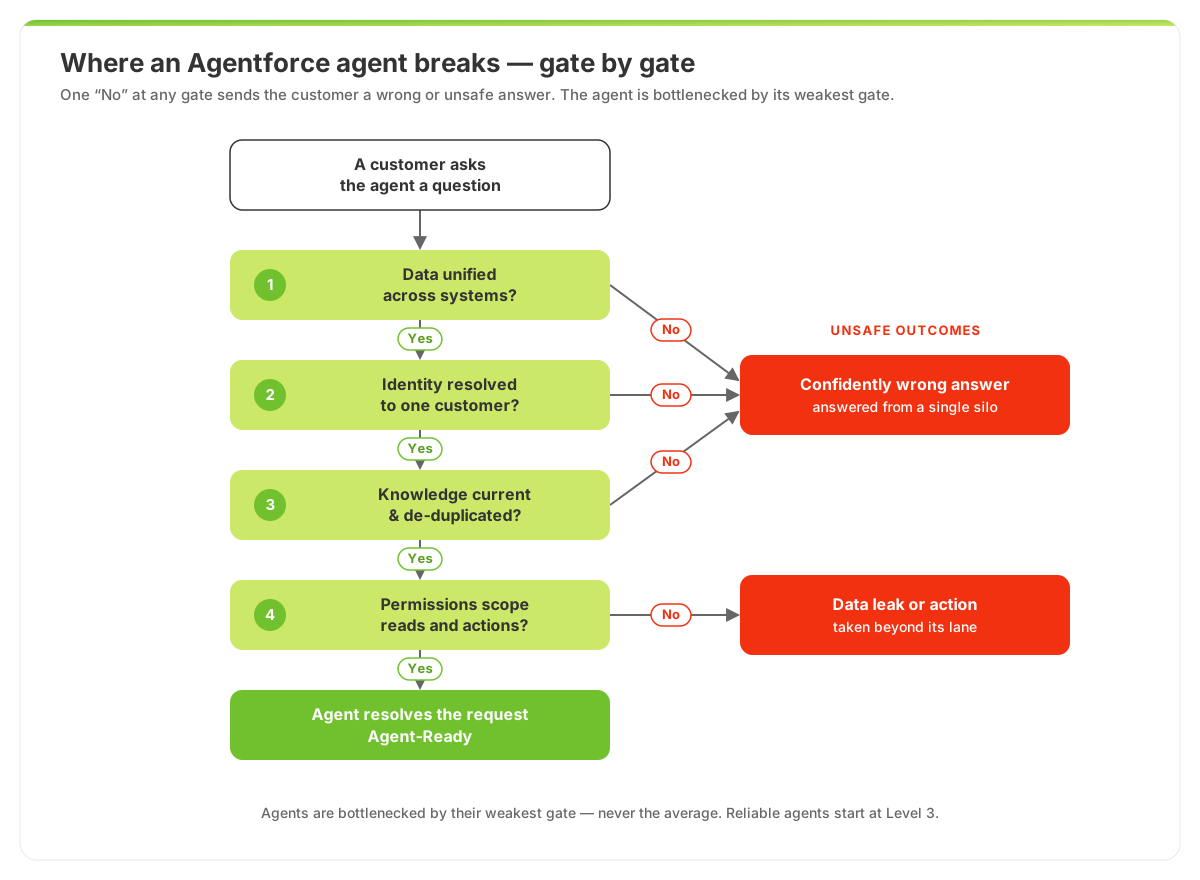 A single “No” at any gate breaks the chain. Agents are bottlenecked by their weakest dimension, not the average.
Read it top to bottom: a single "No" at any gate sends your customer to a wrong or unsafe answer. Agentforce doesn't average your four scores. It's bottlenecked by your weakest one. A Level 5 on data with a Level 1 on permissions is still a data leak waiting to happen.
How do you score your own org in an afternoon?
You don't need a consultant for the first pass. Rate each dimension 1–5 using the table above, then take your lowest score. That's your real level. The honest version of this exercise usually stings.
- Data unification: Count the systems holding customer data. One unified layer = 5. Five disconnected apps = 2.
- Identity resolution: Pull your duplicate rate. Under 2% with active matching = 5. "We have no idea" = 1. The field graveyard cleanup work lives here too. Dead and duplicate fields corrupt what an agent retrieves.
- Knowledge-base hygiene: Pick three common questions. If you can find one current, authoritative answer for each in under a minute, you're a 4+. If you find conflicting versions, you're a 2.
- Permission model: Ask, "Could an agent surface a record or fire an action it shouldn't?" If you can't answer confidently, you're below 3. This is the Einstein Trust Layer governance checklist in practice.
✅ Key Takeaways
- Stop debating whether to buy Agentforce. Score your readiness and debate what gets you to Level 3.
- Agents are graded on four things: data unification, identity resolution, knowledge-base hygiene, and your permission model.
- Your true level is your weakest dimension: agents are bottlenecked, not averaged.
- Most companies sit at Level 2. Reliable agents start at Level 3.
- The license is the cheap part. The readiness work is the project, and it's fundable as ROI, not "cleanup."
What each level-up actually costs you (and saves you)
Here's why this model matters to your P&L: it stops you from buying a Level-4 capability for a Level-2 org. Paying for Agentforce consumption while sitting at Level 2 is paying a meter to generate wrong answers. That's not an AI budget. It's a refund-and-apology budget.
The smarter sequence is to fund the climb to Level 3 first, prove it with a near-zero-cost, two-week Agentforce pilot on one narrow use case, and only then sign a consumption commit. Same destination. You just don't set money on fire on the way there. If you want the formal version of the data work, that's exactly what a data readiness audit produces.
Frequently Asked Questions
What is an Agentforce readiness assessment?
It's a structured scoring of whether your Salesforce org can support AI agents safely. A good assessment grades four dimensions (data unification, identity resolution, knowledge-base hygiene, and your permission model) and places you on a maturity scale. The output is a level plus a prioritized list of what moves you up, not a generic "you're not ready."
What level do we need to be at before buying Agentforce?
Level 3 ("Unified Core") for a single narrow use case, and Level 4 ("Governed & Grounded") before you put an agent in front of customers or let it take actions. Buying at Level 2 means paying consumption costs to generate confidently wrong answers, the worst possible ROI on the platform.
How long does it take to go from Level 2 to Level 3?
For most 50–200 person companies, a focused engagement runs weeks, not quarters, assuming the work is scoped to the data and objects your first use case actually touches. The mistake is trying to unify everything. You only need Level 3 on the slice the agent will use first.
Is this just a sales tactic to gate the Agentforce purchase?
The opposite. ODS makes no money on Salesforce licenses. Salesforce does. We score readiness because deploying an agent into a Level-2 org is how engagements fail and reputations get burned. We'd rather diagnose the prerequisite work honestly than sell you a capability your data can't support yet.
Does the rename to "Data 360" change any of this?
No. It reinforces it. As we covered in why Data Cloud became Data 360, the whole platform is being repositioned around unified, grounded data as the foundation for AI. The readiness levels are just Salesforce's own strategy, restated as a checklist you can act on.
CTA: Get your level before you get a license
You can guess your readiness, or you can score it. Guessing is how a Level-2 org ends up paying for a Level-4 problem.
ODS runs the Agentforce Readiness Scorecard as part of a free Salesforce audit: we score your four dimensions, hand you your level, and map the prioritized, shortest path to Level 3. No license pitch, because we don't sell licenses, we diagnose readiness.
If the audit puts you at Level 1 or 2 with something actively broken, our Emergency package ($4,997) stops the bleeding. If you're a solid Level 2 ready to climb, the Transformation package ($29,997) takes you to a governed, agent-ready core (Agentforce included) under our 30-day milestone guarantee.
Want to see the math first? Model the cost of getting ready against the cost of getting it wrong on our ROI calculator, or just tell us where you think you are and we'll tell you where you actually are.
Stop asking whether you should buy Agentforce. Find out if you're at Level 3.

About the Author
Scott Ohlund
Certified Salesforce Architect with 13+ years of experience. Specialist in AI Agentforce, Data Cloud, and business automation solutions. As founder of Optimum Data Solutions, Scott helps SMB and mid-market teams cut Salesforce tech debt and ship AI-first CRM that actually moves revenue.
Ready to Transform Your Salesforce Experience?
Let's discuss your specific needs and create a customized solution that drives real results for your business.