Your AI Agent Is Going to Fail, and It Won't Be the AI's Fault
TL;DR: Why do AI agent projects fail? Almost never because the model is dumb. They fail because the agent acts on duplicated, stale, ungoverned CRM records your team has quietly been working around for years. Fix the data first, or you're deploying a confident liar straight to your customers.
Here's the part nobody selling you an AI agent will say out loud: your data is not "good enough." It only looks good enough because a human being is silently fixing it thousands of times a day. And you're about to remove that human from the loop.
When executives ask why do AI agent projects fail, they picture a hallucinating chatbot or a model that's "not smart enough yet." That's the wrong autopsy. The model is usually fine. The org underneath it is the corpse.
The hidden subsidy nobody put on the invoice
Your CRM is full of duplicates, dead fields, half-merged accounts, and contacts who left their companies two years ago. You know this. So does your team. And it has never blown up, because a rep looks at the screen, thinks "that's the old account, the real Acme is the other one," and routes around the mess without telling anyone.
That silent correction is a subsidy. Every day, your people pay down your data debt for free, in micro-decisions you never see and never measured. The data isn't clean. It's being cleaned in real time by human judgment. Judgment that never made it into a single field.
The reframe: An AI agent is not a smarter human. It's a more literal one. It does not squint at a record and think "this looks off." It retrieves a record and acts on it, confidently, instantly, at scale. The exact ambiguity your best rep absorbs without blinking is the exact ambiguity that turns an agent into a liability.
This is the aha most buyers miss. The agent doesn't introduce the error. The error was always there. The agent just fires the human who was hiding it from you.
How does an AI agent handle a bad record differently than a human rep?
A human rep absorbs the ambiguity and quietly routes around it; an AI agent executes the bad record literally, at scale. And your customer feels it.
| The record | Your human rep | Your AI agent |
|---|---|---|
| Two "Acme Corp" accounts, one stale | Picks the live one on instinct | Grabs whichever matches first |
| Renewal date blank | Asks a colleague, checks email | Treats blank as "no renewal" |
| Contact left the company | Mentally flags it, calls someone else | Emails a dead inbox, logs success |
| Contradictory notes on the deal | Trusts the newest, ignores the rest | Averages the contradiction into nonsense |
Notice the pattern. The human is lossy-tolerant, built to operate on incomplete, contradictory information. The agent is literal-faithful, built to execute exactly what the data says. Bad data plus a human equals a quiet workaround. Bad data plus an agent equals a confident wrong action your customer actually feels.
Watch one duplicate record take down a deployment
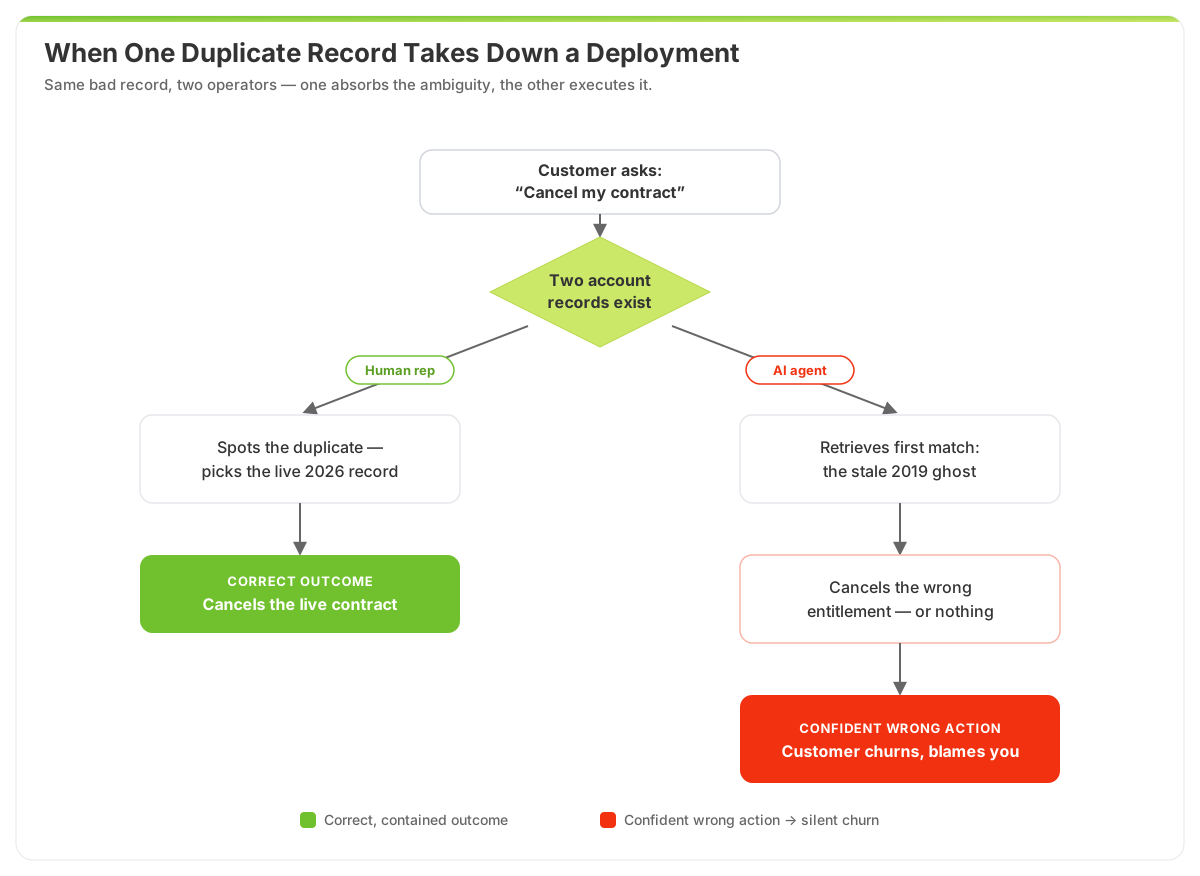 One duplicate record, two operators: the human rep absorbs the ambiguity and cancels the live contract, while the literal-faithful AI agent acts on the stale ghost and drives the customer to churn.
One duplicate. That's all it takes. And duplicates are the cheap problem. The expensive failures come from ungoverned data (fields anyone can write to, with no owner, no validation, no source of truth), where the agent has no way to know which version of reality you actually meant.
This is a P&L problem wearing a data-quality costume
Let's translate it into money. According to Gartner, poor data quality costs organizations an average of $12.9 million per year . And industry analysts widely estimate that roughly 30% of CRM data decays annually as people change jobs, companies merge, and details go stale .
For a company your size, skip the headline number. Run the failure math:
| Scenario | Without data readiness | With data readiness |
|---|---|---|
| Agent handles 1,000 cases/month | ~8% act on a bad record | <1% act on a bad record |
| Wrong actions per month | ~80 | ~10 |
| Avg. cost per wrong action (rework, refund, churn risk) | $250 | $250 |
| Monthly damage | $20,000 | $2,500 |
Same agent. Same license. The only variable is what's underneath it. The unglamorous data work isn't a tax the vendor charges you to go live. It's the single biggest lever on whether the agent makes or loses money. I break down how stale fields quietly bleed budget in the Salesforce field graveyard breakdown.
Why won't your AI vendor lead with data readiness?
Be honest about incentives. The vendor's quota closes when you sign the agent license, not when your data is ready. So data readiness gets framed as your homework, a speed bump before the exciting part. That framing protects their quarter, not yours.
Flip it. Data readiness is risk reduction, and the risk is yours, not theirs. A clean, governed foundation is the only thing standing between "the agent quietly saved us 30 hours a week" and "the agent emailed 400 churned accounts a renewal notice and our CMO found out from a customer." You're not prepping data to please Salesforce. You're protecting your brand from a system that executes your mistakes faster than you can catch them.
It's the same reason I push every client toward a data readiness audit before a consumption commit, and why a low-cost pilot on a narrow, well-governed slice beats a big-bang rollout every time. Find out your data isn't ready in a sandbox, not in front of a customer.
✅ Key Takeaways
- AI agent projects fail on data, not models: the agent removes the human who was silently fixing your records.
- Humans are lossy-tolerant; agents are literal-faithful. The ambiguity your reps absorb becomes the agent's confident error.
- Data readiness is risk reduction for you, not prep work for the vendor's quota. Treat it that way.
- Duplicates and ungoverned fields are the cheapest-to-fix, highest-leverage failure point. Start there.
- Pilot on a clean, narrow slice before signing a consumption commit. Prove it, then scale it.
How do you know if your data is ready for an AI agent?
You're ready when you can name a single source of truth, control who can write to the fields the agent reads, and account for whatever your reps silently route around.
You don't need a six-month cleanup. You need to know your readiness level honestly and fix the load-bearing problems first. Three questions tell you most of it:
- Can you name the source of truth? For accounts, contacts, and entitlements, is there one governed record, or five opinions?
- Who can write to the fields the agent will read? If the answer is "anyone, with no validation," the agent inherits that chaos.
- What does your team silently route around? Ask your reps what they "just know" to ignore. That list is your data debt. Get it out of their heads and into governance.
If those answers make you wince, that's not a reason to delay AI. It's the cheapest, highest-ROI work on your roadmap. Score yourself honestly against the Agentforce readiness scorecard, then sequence the fixes.
Frequently Asked Questions
Why do AI agent projects fail more often than traditional software projects?
Because traditional software waits for a human to make decisions, while agents make decisions autonomously on live data. A bad record in a dashboard is a cosmetic problem a person corrects. The same record handed to an agent becomes an action: an email sent, a case closed, a contract touched. Agents convert silent data debt into visible, customer-facing failures.
Isn't the AI supposed to be smart enough to handle messy data?
The model is smart at language, not at knowing your business truth. It cannot tell which of two "Acme" accounts is real, or that a blank renewal date means "unknown" rather than "none." Those are governance facts, not reasoning problems. No model upgrade fixes a record that contradicts itself. Only data readiness does.
How much data cleanup do we actually need before deploying an agent?
Less than you fear, if you scope it right. You don't boil the ocean. You govern the specific objects and fields the agent will read and write for its narrow use case. A targeted data readiness audit finds the load-bearing problems in days, not months, so you fix what the agent touches instead of everything.
What's the cheapest way to de-risk an AI agent rollout?
Run a tightly scoped pilot on one well-governed use case before signing any consumption commitment. Prove the agent acts correctly on real data at small scale, measure the wrong-action rate, then expand. This surfaces data problems in a sandbox where they cost nothing, instead of in production, where they cost customers.
Who owns data readiness: IT, RevOps, or leadership?
Leadership owns the decision; RevOps and your Salesforce partner own the execution. The trap is treating it as a purely technical cleanup buried in IT. Frame it as a business-risk initiative, because the failure mode is brand damage and churn, which lands squarely on the P&L, not the backlog.
Get your data ready before the agent exposes it
If your gut says your org isn't ready, that gut is the most accurate readiness assessment you own. Don't deploy an agent on top of records your team has been quietly apologizing for.
Start with a free Salesforce audit. We'll map your duplicates, dead fields, and ungoverned objects against the specific agent use case you have in mind, and tell you, plainly, whether you're ready or about to automate your mistakes. If the foundation is broken, our Emergency engagement fixes what's actually load-bearing, fast; if you're ready to scale agents on a clean base, the Transformation package takes it from there. Every engagement carries our 30-day milestone guarantee, and you can model the numbers yourself before you commit a dollar.
Your AI agent will do exactly what your data tells it to. Make sure your data is telling the truth.

About the Author
Scott Ohlund
Certified Salesforce Architect with 13+ years of experience. Specialist in AI Agentforce, Data Cloud, and business automation solutions. As founder of Optimum Data Solutions, Scott helps SMB and mid-market teams cut Salesforce tech debt and ship AI-first CRM that actually moves revenue.
Ready to Transform Your Salesforce Experience?
Let's discuss your specific needs and create a customized solution that drives real results for your business.