Stop Over-Customizing Salesforce: You're Building the Technical Debt That Will Sink Your Next AI Project
TL;DR: Salesforce customization technical debt is the accumulated cost of code written to bend the platform to your process. For companies under 150 users, most of it was avoidable. Now it is the number-one reason Agentforce and AI agents misfire. Configure first. Customize only when revenue or risk truly demands it.
You were warned about this once. Around 2015, every Salesforce blog told you the same thing: don't over-customize, stay on the upgrade path, resist the urge to code your way out of every edge case. You nodded. Then you hired a partner, the partner billed by the hour, and four years later you have 380 custom fields, 22 Apex triggers nobody will touch, and a Flow named Copy of Copy of Lead Router FINAL v3.
That mess has a name: Salesforce customization technical debt. And here's the part nobody told you: it was dormant. It cost you a little speed, a little admin pain, the occasional broken deploy. Survivable. Then Agentforce showed up, and the entire bill came due at once.
What is Salesforce customization technical debt?
Technical debt is the future cost of a shortcut you take today. In Salesforce, that debt is rarely one big mistake. It's a thousand small ones: a custom object that should have been a picklist, a trigger that should have been a Flow, a validation rule firing on a field three teams forgot existed.
Individually, none of them hurt. Collectively, they form an undocumented operating system that lives only in the heads of people who have since left your company. That is the debt. The interest is the time every new change now takes, plus the risk that any change breaks something invisible.
For a 40-person company, this is absurd. You do not have enterprise complexity. You have a partner who got paid to manufacture it.
The configure-vs-customize line partners profit from blurring
Here's the distinction that should govern every decision in your org, and the one most implementation partners quietly smear: configuration versus customization.
- Configuration is clicks. Fields, page layouts, validation rules, standard automation, permission sets. It's declarative, Salesforce-supported, and survives every release. The platform tests it for you.
- Customization is code. Apex, triggers, Lightning Web Components, gnarly multi-object Flows, managed packages bolted on to do things the core never intended. You own it. You test it. You fix it when an upgrade breaks it.
Configuration is an asset. Customization is a liability you sometimes have to accept. Both can solve the same business problem. Only one generates billable hours, maintenance retainers, and the comfortable dependency that keeps a partner on your payroll.
I'll say the quiet part out loud, and it costs me money to say it: most of the custom code in a sub-150-user Salesforce org should never have been written. I've refactored dozens of these orgs. The honest configure-first answer means I bill you less, not more. If your partner has never once told you "don't build that," ask why.
| Configuration (clicks) | Customization (code) | |
|---|---|---|
| Who maintains it | Salesforce | You |
| Survives upgrades | Yes, automatically | Only if you re-test |
| Readable by an AI agent | Cleanly | Rarely |
| Who profits from it | You | Your hourly partner |
| When it's right | Default | When revenue or risk truly demands it |
Why does over-customization break your AI project?
An AI agent reads your org's metadata to do its job, so every undocumented field and silent trigger becomes a rule it can misread. A brittle org produces a brittle agent.
Now the reframe: the thing that turns this from a tidiness lecture into a P&L problem.
An AI agent doesn't work magic on top of your org. It reads your org. Agentforce grounds itself in your metadata and your data model: your objects, your fields, your field descriptions, your automation, your relationships. Every custom field is a sentence in the instruction manual the agent has to follow. Every undocumented trigger is a rule it can't see but still trips over.
So here's the aha: over-customization isn't just tech debt. It's AI debt. And AI is the margin call. Hand an agent a model written in five dialects by four people who quit, and it does exactly what you'd expect. It guesses. It picks the wrong Status__c field out of the three you have. It writes to the object your trigger silently overwrites. It tells your customer something confidently wrong, because your org confidently contradicts itself.
The agent didn't fail because AI is dumb. It failed because it faithfully executed your mess. This is the same root cause behind why most AI agent projects fail before they start. The problem was never the model. It was the foundation you asked it to stand on.
Salesforce reports its agents can hit very high autonomous resolution rates in clean, well-grounded environments. That number is real. It's also measured on orgs that look nothing like yours.
The one decision that prevents the debt
You can't un-build five years of debt in a sprint. But you can stop adding to it today with a single rule applied to every new request: configure unless code is the only honest answer. And even then, only if the requirement ties to real revenue or risk and will outlive a couple of releases.
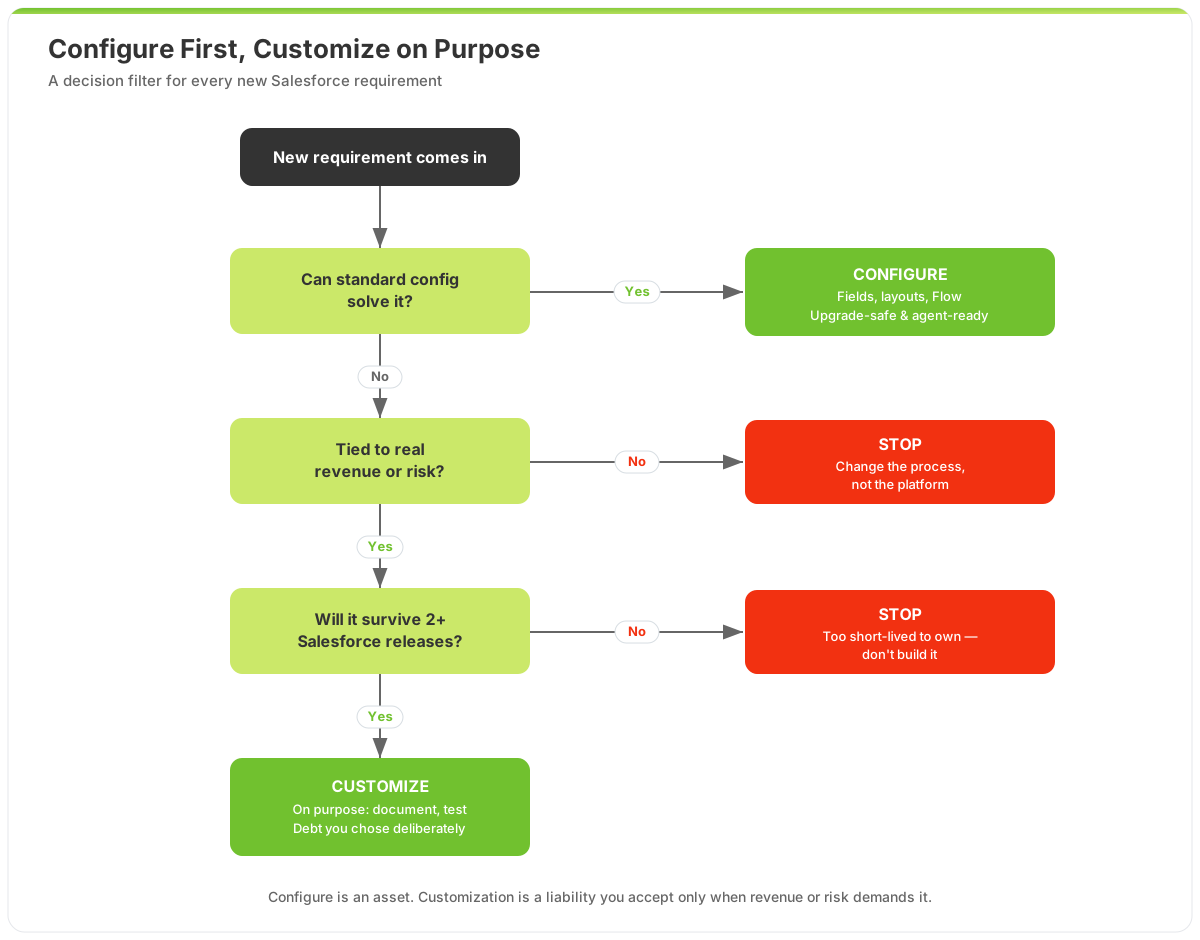 The one rule that stops new debt: configure first, and customize only on purpose.
The goal isn't zero customization. The goal is customization you chose on purpose, documented, tested, and worth its weight, instead of debt you accumulated by accident because "yes, we'll build it" was easier than asking "do we actually need this?"
This is the same logic behind matching architecture to complexity, not ambition. Most of you are reaching for code to solve a problem a picklist and a process change would close for free.
What is Salesforce technical debt costing you right now?
It bleeds time on every change, breaks deploys on each release, fills your org with dead fields, and stalls your AI pilot.
Even before AI, this debt runs a meter. Industry research has long pegged a meaningful share of every IT budget as servicing technical debt rather than building anything new. In a small Salesforce org, here's where it leaks:
| Hidden cost | What it looks like in a 75-person org |
|---|---|
| Slower changes | A "simple" field change takes days because nobody knows what the trigger does |
| Failed deploys | Apex tests break on every release; you pay a developer to babysit upgrades |
| Dead fields | In the orgs we audit, well over half of custom fields go unused, confusing reports and agents alike |
| Stalled AI | Your Agentforce pilot underperforms and gets blamed on "the AI" |
| Key-person risk | One ex-contractor is the only person who ever understood the architecture |
Two of those rows (dead fields and stalled AI) are the cheapest to fix and the most expensive to ignore. Clearing out the field graveyard quietly draining your org is often the highest-ROI hour you'll spend this quarter, precisely because it shrinks the manual your agent has to read.
✅ Key Takeaways
- Configuration is an asset; customization is a liability you should accept only when revenue or risk demands it.
- Most custom code in a sub-150-user org should never have been written, and partners who bill hourly are incentivized not to tell you.
- Over-customization is AI debt. Agents read your metadata, so a brittle org produces a brittle agent, and the AI takes the blame.
- Stop the bleeding with one rule: configure first, customize on purpose, never by accident.
- The cheapest path to a working AI rollout is usually cleanup, not more code.
Frequently Asked Questions
How do I know if my Salesforce org is over-customized?
Three fast signals: a single change takes days because someone has to investigate side effects first; your last few Salesforce releases broke Apex tests; and more than half your custom fields are empty or unused. If a new admin can't explain what a given trigger does within a week, that's undocumented customization technical debt by definition. A readiness assessment will quantify it precisely.
Isn't some customization necessary to fit my business?
Yes, but far less than you've been sold. Genuine competitive differentiation sometimes requires code. The test is whether the requirement ties to real revenue or risk and will survive future releases. Most "we need it customized" requests are process problems dressed up as platform problems. Change the process, keep the platform clean, and reserve code for the handful of things that truly move money.
Will cleaning up technical debt break my org?
Not if it's done surgically. The wrong way is a bulk find-and-replace that nukes a load-bearing field. The right way is dependency-mapped: identify what each field, trigger, and Flow actually touches before removing anything, then stage changes through a sandbox with tests. Done correctly, remediation is low-risk and reversible. Done recklessly, it's how orgs get destroyed, which is exactly why it deserves a real engagement, not a weekend.
Why would a Salesforce partner tell me to customize less if it costs them work?
Most won't. And that's the point. Hourly billing rewards complexity. ODS works on fixed-price, ROI-guaranteed packages, so a leaner org is in our interest too. When you don't profit from the bloat, "don't build that" becomes the honest default answer instead of the unprofitable one.
Can I run Agentforce on a messy org if I just clean the data?
Clean data helps, but it isn't enough. Agents ground on your data model (the objects, fields, and automation), not just the records inside them. Conflicting fields and undocumented triggers will mislead an agent even with pristine data. You need both: a clean model and clean data. That combined groundwork is what separates an agent that helps customers from one that confidently misinforms them.
CTA: Clean the foundation before you build the agent
If you're planning an AI rollout this year, the highest-value move isn't buying more Agentforce credits. It's finding out how much customization technical debt your agent is about to inherit, and fixing the cheap, high-impact parts first.
Start with a free Salesforce audit. We'll map your custom fields, triggers, and Flows, flag the dead weight, and tell you honestly whether you have a process problem or a platform problem. No upsell to a six-month rebuild you don't need.
If the audit surfaces a real mess that's blocking your AI plans, our Growth package is built for exactly this: remediate the debt, document what stays, and get your org agent-ready, without the hourly-billing incentive to keep it complicated. Want the numbers first? Model the cost of carrying versus clearing the debt in our ROI calculator. Most teams are surprised how fast the cleanup pays for itself.
Your future AI agent is only as good as the org it has to read. Hand it something clean.

About the Author
Scott Ohlund
Certified Salesforce Architect with 13+ years of experience. Specialist in AI Agentforce, Data Cloud, and business automation solutions. As founder of Optimum Data Solutions, Scott helps SMB and mid-market teams cut Salesforce tech debt and ship AI-first CRM that actually moves revenue.
Ready to Transform Your Salesforce Experience?
Let's discuss your specific needs and create a customized solution that drives real results for your business.