Stop Paying for Seats Nobody Logs Into: Salesforce as Your Orchestration Engine, Not Your Destination
TL;DR: The choice between Salesforce consumption pricing vs per-seat licensing comes down to one fact: per-seat charges you for chairs whether or not anyone sits in them. Consumption pricing lets mid-market companies expose CRM data and actions inside Slack, the website, and AI assistants, and pay for outcomes. Keep full seats only for power users who truly live in the platform.
Pull your Salesforce login report for the last 90 days. I'll wait.
In thirteen years of cleaning up orgs, one number ends the meeting every time: how many people you pay for versus how many actually open the app in a given week. It's rarely above half. You bought 60 seats. Twenty-two people logged in this month. The rest are paying customers of a product they refuse to use.
That's not a training problem. It's a pricing-model problem. The math behind Salesforce consumption pricing vs per-seat is the first thing to change in fifteen years that actually fixes it.
The reframe: your CRM was never supposed to be a place people go
Here's the aha. For two decades, Salesforce sold you a destination. The deal was simple: pay per chair, and everyone marches into the same screen to do their work. Adoption was your problem. If a rep avoided the app, you bought more training, more dashboards, more nagging from the VP of Sales.
But your CRM's real job was never to be a building people walk into. It was to be a brain that other things call. The system of record. The place where the rules live, the data is governed, the automation fires. Whether a human stares at it directly is almost beside the point.
Per-seat pricing forced you to confuse the two. You paid for attendance when what you wanted was outcomes. Consumption pricing (flex credits, pay-per-resolution, metered platform actions) finally lets you pay for the second thing. And once you pay for outcomes, the question stops being "how do we make everyone log in?" and becomes "why are we making them log in at all?"
This is the move from system of record to system of orchestration. For a CFO or COO, that's not a tech decision. It's a budgeting decision.
What does "orchestration engine, not destination" actually look like?
You don't drag 60 people into Salesforce. You push Salesforce out to where those 60 people already spend their day (Slack, your website, their inbox, an AI assistant) and let the platform do the work underneath.
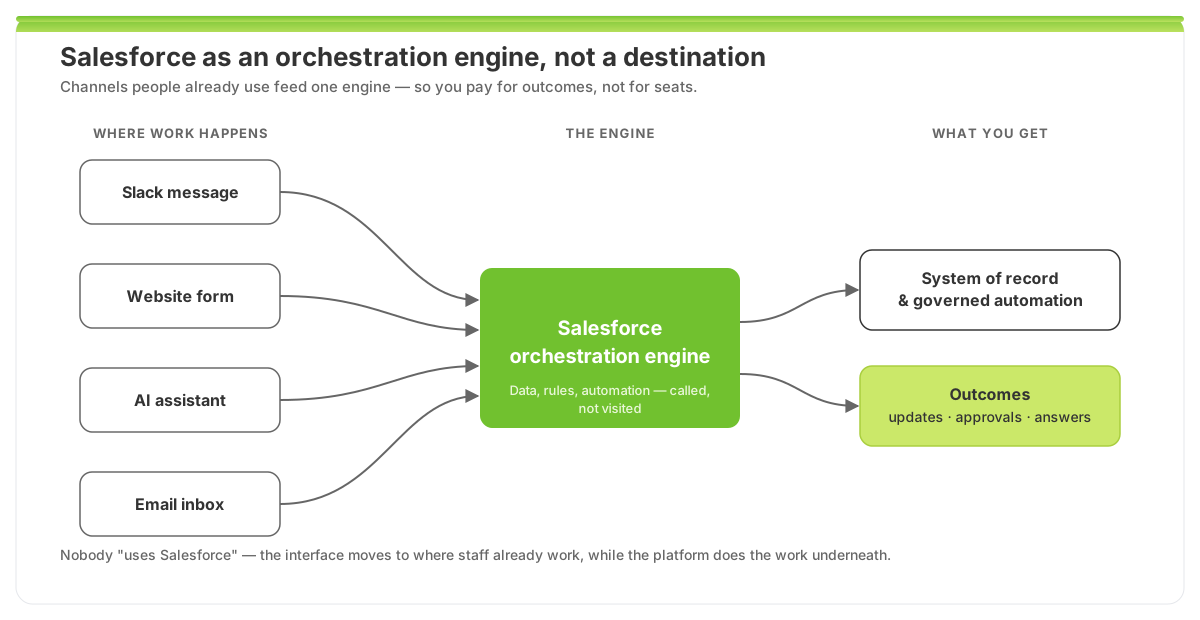 Push Salesforce out to where people already work: channels feed one engine, and you pay for outcomes instead of seats.
An ops manager approves a discount from a Slack button. A customer checks order status on your website and the answer comes straight out of Salesforce with no human in the loop. A rep asks an AI assistant "what's the latest on the Henderson account?" and gets a grounded answer. No login, no tab-hunting. Salesforce did all of it. Nobody "used Salesforce."
That's the practical core of Headless 360, explained for a 50-person company: the data and logic stay in Salesforce; the interface moves to wherever work happens. Just know going in that exposing your org this way also surfaces every mess in it, a point I make bluntly in Headless 360 won't save your business, it'll expose your org.
Salesforce consumption pricing vs per-seat: the cost math your CFO will care about
Let's make it concrete. Take a 150-person company that bought 60 Sales and Service Cloud Enterprise seats. Here's the status quo versus the orchestration model.
| Line item | Per-seat status quo | Orchestration model |
|---|---|---|
| Full Enterprise seats | 60 × ~$165/user/mo | 18 power-user seats |
| Annual license cost | ~$118,800 | ~$35,640 |
| Occasional users (42) | Paying full freight, ~20 actually log in | Interact via Slack / web / AI |
| Consumption / metered usage | $0 | ~$25,000/yr |
| Total annual | ~$118,800 | ~$60,640 |
| You're paying for | Chairs | Outcomes |
That's roughly $58,000 a year you were spending to reserve seats for people who avoid the app. Orchestration isn't automatically cheaper for everyone. If all 60 users genuinely live in Salesforce every day, per-seat may still win. But that's exactly the company you don't have. Adoption reality is the whole point.
The adoption number nobody wants to say out loud
Low CRM adoption isn't a rumor. Usage has been soft for years. Salesforce's own State of Sales research has repeatedly found reps spend well under a third of their time actually selling , with the rest lost to admin and tool-switching. Every minute a rep spends hunting through CRM tabs is a minute you pay for twice: once for the seat, once for the lost selling time.
Per-seat pricing quietly taxes that dysfunction. Orchestration pricing removes the tax. When the rep gets the answer in Slack, you stop paying for the seat and you get the minute back.
How do you decide who keeps a full Salesforce seat?
Keep full seats for the builders and daily power users who live in the platform, and move occasional contributors and pure data consumers off them.
Not everyone should move to consumption. The framework I use is dead simple:
- Builders and power users (admins, RevOps, full-time sellers, service agents working cases all day) → keep full seats. They live in the platform; the destination is their job.
- Occasional contributors (approvers, execs checking a number, field staff updating one record a week) → move to orchestration. Slack actions, a portal, or an AI assistant.
- Pure consumers of data (anyone who just needs an answer and never edits) → never needed a seat in the first place.
If you've been buying full Enterprise licenses for that bottom two-thirds, you've been funding a destination for people who only ever wanted a doorway. This is also the cleanest way to settle the consultant-vs-full-time-admin question: you need fewer seats and sharper architecture, not more headcount staring at screens.
A word of caution from the cleanup trenches: orchestration only works if the engine underneath is sound. Exposing a messy org through Slack just lets more people touch the mess faster. Before you re-platform the interface, get honest about the data and the automation. The honest version of that long-term number lives in the 3-year total cost of Salesforce for a company your size, and the architecture call itself is a native vs. composable decision tree. Match it to your complexity, not your ambition.
✅ Key Takeaways
- Per-seat pricing taxes low adoption. You pay for chairs whether or not anyone sits in them. Consumption pricing lets you pay for outcomes instead.
- Your CRM is a brain to be called, not a building to visit. Push it into Slack, your website, and AI assistants where staff already work.
- Segment your users. Full seats for builders and daily power users; orchestration for occasional contributors; nothing for pure data consumers.
- Cheaper isn't automatic. If everyone truly lives in Salesforce, per-seat can still win. The savings come from the gap between seats bought and seats used.
- Architecture first. Orchestration on a messy org just spreads the mess. Clean the engine before you move the interface.
Frequently Asked Questions
Is Salesforce consumption pricing always cheaper than per-seat?
No. Consumption wins when you're paying for seats people rarely use, the common mid-market reality. If every licensed user genuinely works in Salesforce all day, per-seat is often cheaper and more predictable. The deciding factor is the gap between seats you bought and seats people actually use. Run your login report before assuming either way.
Do we still need any Salesforce licenses if we go orchestration-first?
Yes. Someone has to build and govern the engine. Your admins, RevOps, and daily power users keep full seats, and the platform itself still requires a base subscription. The shift isn't "zero licenses." It's matching license type to actual behavior, so you stop buying full Enterprise seats for people who edit one record a month.
Won't exposing Salesforce in Slack or on our website create a security risk?
Only if you skip governance, which you shouldn't. Orchestration runs through the same permission model, sharing rules, and audit trail as a direct login; the interface changes, not the controls. The bigger risk is the opposite: dozens of underused full-access seats are a wider attack surface than a handful of governed, scoped integrations.
Isn't this just a rebrand of "buy Headless 360 and re-architect everything"?
No. Headless 360 is one way to deliver orchestration, but you can start far smaller: a few Slack actions, one website self-service flow, an AI assistant grounded on your data. Prove the model on one workflow, measure the seat savings, then expand. You don't need a platform re-architecture to stop paying for dead seats.
How do I know which seats to cut first?
Start with your 90-day login report. Any licensed user who hasn't logged in this quarter is a candidate to move to orchestration immediately. Cross-reference with role: if they're an approver, exec, or occasional updater, they almost never needed a full seat. That list, multiplied by your per-seat cost, is your first-year savings number.
CTA: Find your dead seats before your next renewal
Your renewal date is the deadline that matters. The worst time to discover you're paying for 38 logins nobody uses is the week after you re-upped for another year.
We'll find them for you. A free Salesforce audit pulls your actual login and usage data, maps it against what you pay per seat, and shows you exactly which users belong on full licenses, which belong in Slack, and which never needed access at all. Want to gut-check the savings yourself first? Run the numbers in our cost savings calculator or model the upside in the ROI calculator.
If the audit shows a real gap, our Growth engagement is built for exactly this: re-architecting Salesforce from a destination your team avoids into an orchestration engine your team never has to think about. Fixed price, ROI-guaranteed, with a 30-day milestone. See how that's scoped on the packages page, or start a conversation.
Stop paying for chairs. Start paying for outcomes.
Scott Ohlund, Founder & Chief Salesforce Architect, ODS

About the Author
Scott Ohlund
Certified Salesforce Architect with 13+ years of experience. Specialist in AI Agentforce, Data Cloud, and business automation solutions. As founder of Optimum Data Solutions, Scott helps SMB and mid-market teams cut Salesforce tech debt and ship AI-first CRM that actually moves revenue.
Ready to Transform Your Salesforce Experience?
Let's discuss your specific needs and create a customized solution that drives real results for your business.