Salesforce Consultant vs. Full-Time Admin: Which One Your Business Actually Needs (and What Each Really Costs)
TL;DR: The Salesforce consultant vs admin hire decision isn't one role versus the other. It's labor versus judgment. A full-time admin buys maintenance capacity: tickets, fields, reports, user support. A consultant buys architecture decisions: data model, integrations, and AI guardrails that decide whether your org scales or rots. Most 10-500 person firms need both, in sequence.
Here's the trap. Salesforce starts misbehaving, the backlog of requests piles up, and hiring a full-time admin feels like the responsible move. You post the job, pay $90K, and tell yourself the org is finally "owned."
It isn't. You bought hands. You didn't buy a brain for the parts that actually break.
That's the reframe most of the Salesforce consultant vs admin hire debate misses. People argue it like a coin flip between two interchangeable people. It's not. An admin and an architect-grade consultant do fundamentally different work, and confusing the two is how a 60-person company ends up with a tidy-looking org that quietly can't survive its next growth phase, or its first AI project.
I've cleaned up dozens of these orgs. The pattern is almost always the same: a competent, hardworking admin who was set up to fail, because they were handed decisions no single in-house generalist should own alone.
The work splits into two piles, not one
Stop asking "who runs Salesforce." Start asking "what kind of work does running Salesforce actually require." There are two piles, and they demand different skills, different cadences, and very different price tags.
Pile one: maintenance and execution. Password resets, new users, page layouts, validation rules, dashboards, the weekly report the VP of Sales wants, onboarding the new SDR cohort. This is real, constant, valuable work. It's also admin-grade work, and a good admin is worth every dollar.
Pile two: architecture and judgment. How should the data model represent your business? When do you integrate versus duplicate? What guardrails go in before you let AI touch a customer record? Custom object or workaround? This work is infrequent but decisive. Get it wrong once and you create technical debt that compounds for years.
Here's the AHA: a full-time admin gives you continuous coverage of the pile that's loud but low-stakes, and near-zero coverage of the pile that's quiet but determines whether the whole thing survives scale. The requests that scream are rarely the decisions that matter. The decisions that matter rarely scream. Not until the AI project fails and everyone wonders why.
Why one admin can't own the architecture pile
This isn't a knock on admins. It's a knock on the org chart. Owning data modeling, integration strategy, and AI guardrails takes someone who has architected across many orgs and watched each decision play out three years later. A single in-house admin, even a great one, has seen exactly one org deeply: yours. They're learning your business and your platform architecture at the same time, usually while drowning in pile one.
Ask a solo admin to design your integration strategy, govern your Einstein Trust Layer policies, and keep the lights on, and you've handed one person three jobs that belong to three different skill levels. Something gives. Usually it's the quiet pile, because nobody files a ticket for "our data model won't survive Agentforce." This is the same dynamic that produces the field graveyard quietly costing you every quarter and the over-customization that becomes the technical debt sinking your next AI project.
What does a Salesforce consultant vs admin actually cost?
Plan on roughly $95K–$140K a year fully loaded for a full-time admin, versus about $5K–$30K per engagement for a fractional or project consultant. The two cover fundamentally different work.
Let's do the math business buyers actually care about. The figures below are typical US ranges; verify against your market before you budget.
| Option | Annual cost (fully loaded) | What you get | What you DON'T get |
|---|---|---|---|
| Full-time admin | ~$95K–$140K | Daily maintenance, user support, reports, small builds, institutional knowledge | Senior architecture judgment, integration strategy, AI/data-model design |
| Fractional / project consultant | ~$5K–$30K per engagement | Architecture, integrations, guardrails, a roadmap, knowledge transfer | Daily hands-on coverage, sitting in your standups, being a Slack ping away |
| Both (the real answer) | Admin salary + periodic consulting | Coverage AND judgment: consultant sets direction, admin executes | A reason to overpay for either one alone |
The base salary is only half the story. A $90K admin is realistically a $110K–$135K line item once you add payroll tax, benefits, software, and management overhead. And that buys availability, not seniority. Expect that one hire to also be your architect and you're paying senior-org prices for mid-level execution.
Compare that to a fixed-scope engagement. ODS prices its packages at $4,997 (Emergency, fix what's broken), $14,997 (Growth, scale without chaos), and $29,997 (Transformation, Agentforce + advanced automation). Even the top tier is a fraction of a year of fully-loaded admin salary, and it buys the exact pile an admin structurally can't cover. That's not a pricing coincidence. It's a reflection of how the work splits. Want to run your own numbers? The ROI calculator and cost-savings calculator will do it with your inputs.
Should you hire a Salesforce consultant or a full-time admin?
Diagnose the pain first: if it's pure volume, hire the admin; if any part of it is architectural, you need the consultant. Most firms eventually need both, in sequence.
Most firms don't actually face an either/or. They face a sequencing question: who sets the architecture, and who maintains it. Here's how I tell clients to decide.
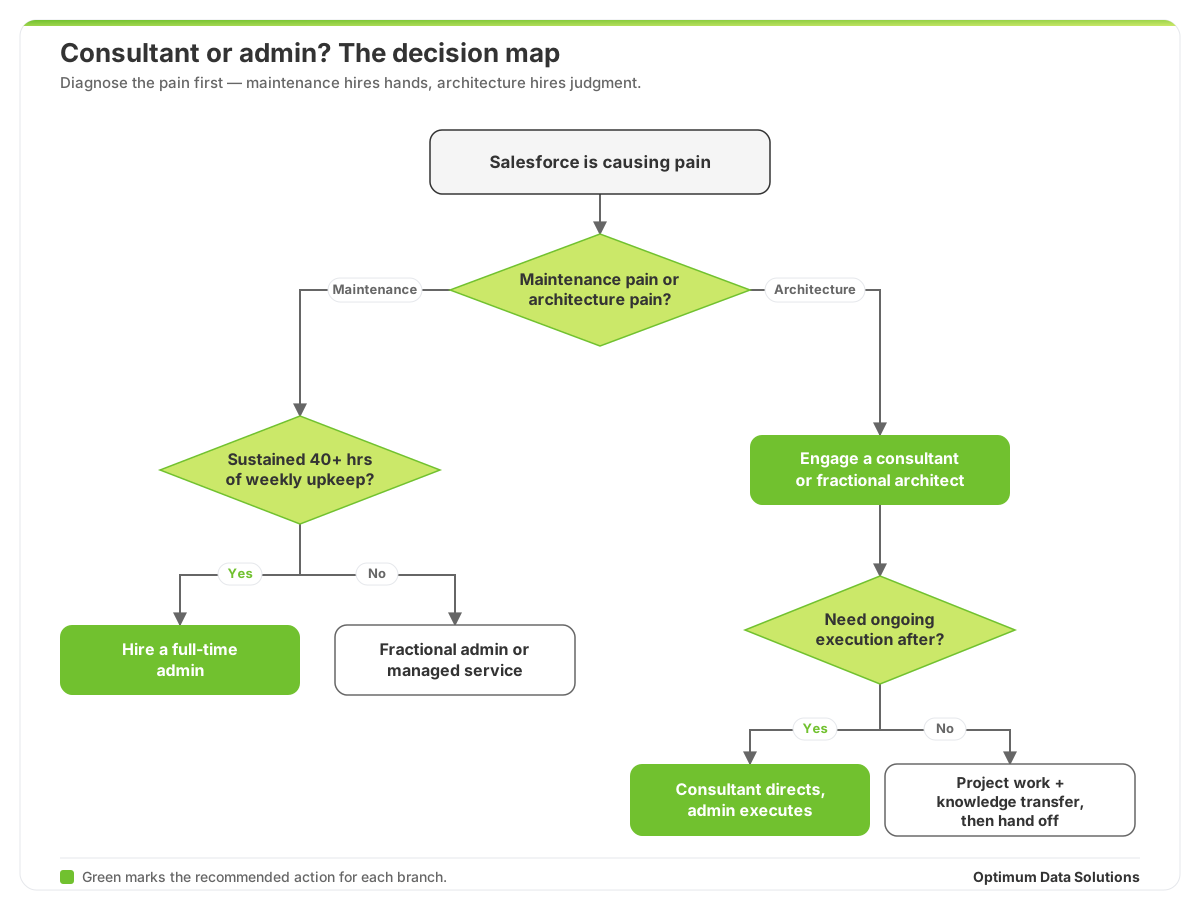 Diagnose the pain first: maintenance pain points to an admin, architecture pain points to a consultant.
The honest reading of that diagram: if your only pain is volume, hire the admin. If any part of your pain is architecture, no admin solves it. And the bigger your AI or integration ambitions, the more the consultant has to come first. You do not want your admin discovering the data model is wrong after they've built fifty automations on top of it.
The sequencing that actually works
For most 10-500 person firms I work with, the winning play is consultant-first, admin-second:
- Consultant sets the foundation: clean data model, integration strategy, naming conventions, guardrails, a documented roadmap. Verify: the architecture is written down and an admin could execute against it.
- Admin owns the day-to-day: executes the roadmap, handles the loud pile, builds against the standards the consultant set. Verify: backlog burns down without new tech debt appearing.
- Consultant returns for decisions, not tickets: quarterly or per-project, for the AI rollout, the acquisition integration, the Data 360 question. Verify: every major architecture call gets senior eyes before it ships.
This is also how you dodge the most expensive outcome: hiring an admin, letting them build for two years with no architectural oversight, then paying a consultant more to unwind it than it would have cost to set it up right. If you're weighing whether you even need ongoing help, our breakdown of where consulting and in-house headcount each fit is worth a read.
✅ Key Takeaways
- Admin = labor, consultant = judgment. Different work, not different names for the same role.
- One in-house admin cannot own data modeling, integrations, AND AI guardrails alone. That's three skill levels in one chair.
- A full-time admin runs ~$95K–$140K fully loaded; a fixed-scope engagement is a fraction of that and covers the pile an admin structurally can't.
- Sequence it: consultant sets the architecture, admin maintains it, consultant returns for big decisions.
- If any of your pain is architectural, no amount of admin hours fixes it. And an AI project will expose it fast.
Frequently Asked Questions
Can't a senior Salesforce admin just do the architecture work too?
Some can, occasionally. But "senior admin who is also a true architect" is rare, expensive, and hard to retain at a 60-person company. They get bored without a platform team. And even a strong admin only knows your org. Architecture judgment comes from watching many orgs make the same decision and age differently. You're better off buying that judgment in concentrated doses than hoping one hire happens to have it.
Isn't a consultant more expensive than just hiring someone?
Per hour, yes. Per outcome, almost never. A consultant is engaged for the rare, high-leverage decisions, not 40 hours a week of maintenance. A $15K–$30K engagement that prevents a broken data model saves you the six-figure remediation later. The mistake is comparing a consultant's day rate to an admin's hourly rate. Compare what each prevents, not what each costs per hour.
We already have an admin and things feel fine. Do we need a consultant?
"Fine" usually means the loud pile is handled. The real question is whether the quiet pile is. Ask: is our data model documented and intentional? Could we ground an AI agent on our data tomorrow without it confidently misinforming customers? If you're not sure, that's the gap. A short data readiness audit answers it before an AI project forces the answer the hard way.
When is a full-time admin clearly the right call?
When you have sustained, 40-plus hours a week of genuine maintenance and user-support demand, and your architecture is already sound. High user count, frequent process changes, heavy reporting: that's admin territory, and a good one pays for themselves. Just don't silently expect them to also be your architect. If volume is bursty rather than constant, a fractional admin or managed service usually beats a full-time hire.
What about an admin plus a consultant, isn't that paying twice?
It's paying once for each of two different jobs. The admin executes; the consultant decides. That's not redundancy. It's the org chart a real platform team has, compressed to fit your size. The consultant's direction makes your admin more effective, because they're building against a sound foundation instead of inventing architecture on the fly between tickets.
CTA: Find out which pile is actually hurting you
You don't have to guess whether your pain is maintenance or architecture. That's exactly what a free Salesforce audit is for. We look at your org, tell you honestly whether you need hands, judgment, or both. And we don't pretend the answer is always "hire us full-time."
If the audit surfaces real architecture debt, our Emergency package ($4,997) stabilizes what's broken fast, and Growth ($14,997) sets the foundation your in-house admin can execute against for years. Either way, you'll leave knowing what each path costs for your business, not a generic benchmark. Book the audit, or run the numbers yourself first. Decide with math, not with the comforting feeling that hiring someone means the problem is owned.

About the Author
Scott Ohlund
Certified Salesforce Architect with 13+ years of experience. Specialist in AI Agentforce, Data Cloud, and business automation solutions. As founder of Optimum Data Solutions, Scott helps SMB and mid-market teams cut Salesforce tech debt and ship AI-first CRM that actually moves revenue.
Ready to Transform Your Salesforce Experience?
Let's discuss your specific needs and create a customized solution that drives real results for your business.