Salesforce Just Walked Back Fully Autonomous AI Agents, and That's the Best News a Cautious SMB Will Get All Year
TL;DR: No, Agentforce AI agents are not fully autonomous. Salesforce quietly stopped pretending they should be. The platform now pairs deterministic, scripted rules with LLM reasoning, so a 50-person company can bound exactly what an agent may do on refunds, billing, and customer promises before it ever talks to a customer.
Every cautious owner is really asking one question: are Agentforce AI agents fully autonomous, and could one of them issue a $4,000 refund or promise a delivery date I can't hit? The 2024 headlines said yes: "autonomous agents," "digital labor," AI that "acts on its own." The product Salesforce actually ships in 2026 says something far more reassuring: not without your permission, and not outside the lines you draw.
That walk-back isn't a retreat. It's the single most important design decision Salesforce has made for companies your size. Almost nobody is reading it that way.
Are Agentforce AI Agents Fully Autonomous? Not Anymore, and That's the Point
The early Agentforce pitch leaned hard on autonomy. Hand the agent a goal, let the large language model reason its way to an outcome, get out of the way. Great demo. Terrible idea for a business where one hallucinated refund policy wipes out a week of margin.
What changed is architectural, and you have to read the agent builder, not the keynote, to see it. Salesforce moved toward a hybrid model: deterministic scripting for the decisions that carry money and legal risk, and LLM reasoning for the squishy, language-heavy parts where models genuinely shine.
Picture it as two different brains doing two different jobs:
- The deterministic brain (scripting): rigid if/then logic you define. "If refund amount is over $200, route to a human." It does not improvise. It cannot be talked out of the rule by a clever customer.
- The reasoning brain (the LLM): writes the empathetic reply, interprets a messy customer message, picks the relevant knowledge article. It's flexible, and flexibility is exactly what you do not want governing your bank account.
Here's the reframe: autonomy was never the feature you wanted. Bounded competence was. You don't want an agent that can do anything. You want an agent that does a small number of things flawlessly and refuses (loudly, predictably) to do anything else.
Why Is "Less Autonomous" Worth More to Your P&L?
Because the bounded agent is the one that actually ships: cheaper to insure, cheaper to govern, and faster to approve internally than an open-ended autonomous one.
Gartner has predicted that over 40% of agentic AI projects will be scrapped before the end of 2027, citing escalating costs, unclear business value, and inadequate risk controls. The projects that survive won't be the most autonomous. They'll be the most bounded: the ones where a CFO can read a one-page description of what the agent is allowed to touch and sign off without flinching.
This is the same failure pattern I see when an "AI project" collapses for reasons that have nothing to do with the AI. (I dug into the real culprit in why AI agent projects fail on data readiness.) Open-ended autonomy multiplies that risk. Scripted guardrails cap it.
Here's the practical translation for an SMB:
| Fully Autonomous Agent (the 2024 pitch) | Bounded Agent (what ships in 2026) | |
|---|---|---|
| Refund decisions | LLM reasons about the policy | Hard-coded rule; over a threshold → human |
| Failure mode | Confident, wrong, expensive | Stops and escalates |
| CFO sign-off | "Absolutely not" | "Show me the rules. Okay" |
| Audit trail | Reconstruct the model's reasoning | Deterministic, logged, repeatable |
| Who's accountable | Ambiguous | You, by design |
The right-hand column is cheaper to insure, cheaper to govern, and faster to approve internally. That's not a worse product. That's a product that can actually get deployed at a company where the owner signs the refund checks.
What Does a Bounded Refund Agent Actually Look Like?
A bounded refund agent lets deterministic gates control the money and escalation, while the LLM is limited to drafting the language. It never decides the refund itself.
Let's make it concrete. A customer asks for a refund. Here's the flow when the deterministic layer is doing its job and the LLM is kept on a leash:
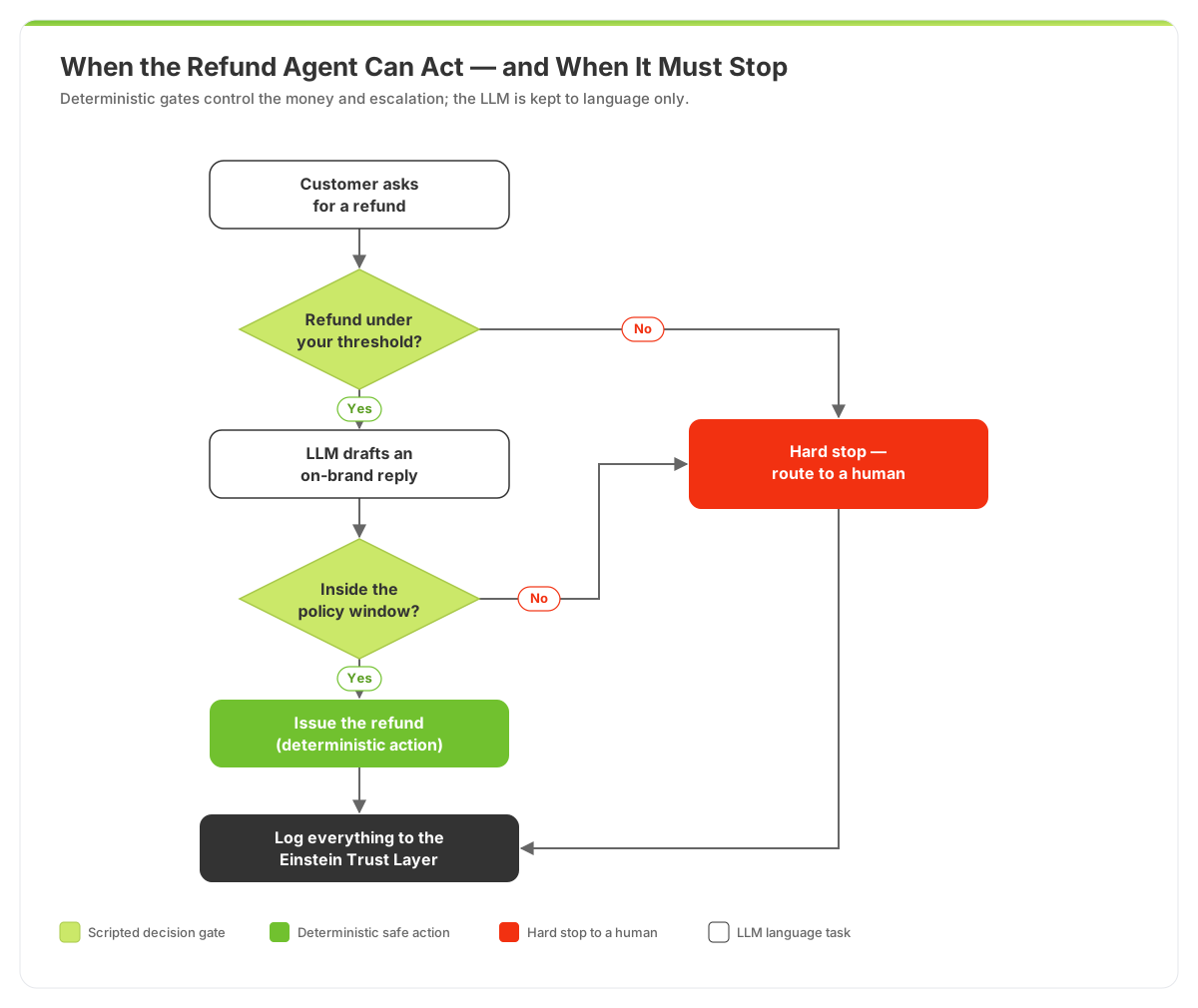 A bounded refund agent: deterministic gates control the money and escalation, while the LLM is limited to language.
Notice where the LLM is allowed to operate: it writes the words. It never decides the money. The diamonds (the money-and-risk decisions) are deterministic gates the model cannot reason its way around. That's the whole game.
This pattern maps cleanly to the handful of jobs that actually pay off for a company your size. If you want the shortlist, I laid it out in the 3–4 Agentforce use cases that work for a 50-person company. And every one of them assumes bounded, not autonomous, behavior.
Read the Architecture, Not the Press Release
This is where most buyers go wrong. They evaluate Agentforce by the marketing narrative ("autonomous digital labor") and either get scared off or get oversold. Both reactions come from reading the keynote instead of the builder.
When you open the actual agent configuration, you're defining three things:
- Topics: the buckets of work the agent is even allowed to engage with. Everything outside the topics simply doesn't exist to the agent.
- Actions: the specific, often deterministic operations (a Flow, an Apex method, an API call) it can invoke. This is where you wire in the hard gates.
- Instructions and guardrails: natural-language and scripted boundaries, all observed and filtered by the Einstein Trust Layer, which masks sensitive data and enforces what the agent can and can't say.
That third layer is your board-level safety story, and it deserves its own checklist. I wrote a plain-English one in the one-page AI control checklist your board will ask for. The point for now: the controls exist because Salesforce conceded that pure autonomy was the wrong default. They built the fence. Your job is to decide where it goes.
✅ Key Takeaways
- Agentforce agents are not fully autonomous. Salesforce now blends deterministic scripting with LLM reasoning on purpose.
- Autonomy was never the goal; bounded competence is. An agent that flawlessly does five things beats one that vaguely attempts fifty.
- Put deterministic gates on anything involving money, legal promises, or compliance. Let the LLM handle language, tone, and retrieval, nothing that moves a dollar.
- Evaluate the agent builder, not the keynote. Topics, actions, and the Einstein Trust Layer are where the real risk controls live.
- A bounded agent is easier to get approved by your CFO, your board, and your own gut.
Frequently Asked Questions
Are Agentforce AI agents fully autonomous?
No. Agentforce agents operate inside boundaries you define: topics, actions, and guardrails enforced by the Einstein Trust Layer. The platform uses deterministic scripting for high-risk decisions (refunds, billing, commitments) and reserves the LLM for language and reasoning tasks. You decide what the agent may do; it does not invent new powers for itself.
What's the difference between scripted rules and LLM reasoning?
Scripted rules are rigid if/then logic that always behaves the same way, ideal for money and compliance decisions where you need predictability and an audit trail. LLM reasoning is flexible and language-aware, ideal for drafting replies, interpreting messy questions, and pulling the right knowledge. Good agent design uses each where it's strong and never lets the LLM control a financial action directly.
Can I limit what an Agentforce agent does with refunds or billing?
Yes. And you should. Wire financial actions behind deterministic gates: thresholds, policy-window checks, and mandatory human escalation above a dollar amount. The agent's LLM can explain and empathize, but the actual refund only fires when your hard-coded conditions are met. This is exactly the control a cautious SMB needs before going live.
Does bounding an agent make it less useful?
The opposite. Bounded agents are the ones that survive procurement, pass a CFO's review, and stay deployed. According to Gartner, a large share of agentic AI projects will be canceled by 2027, usually for weak controls and unclear value, not weak models. Constraints are what make an agent safe enough to actually ship.
How do I know if my org is even ready for a bounded agent?
Start with your data and your processes, not the agent. If your refund policy lives in three different people's heads, an agent can't enforce it, bounded or not. A readiness audit maps where your deterministic gates would go and flags the gaps. We cover the maturity ladder in the Agentforce readiness scorecard.
CTA: Draw the Fence Before You Turn It On
The smartest move Salesforce made was admitting the agent needs a fence. The smartest move you can make is deciding where that fence goes (on refunds, on billing, on every promise an agent could make to a customer) before you flip it on, not after the first expensive mistake.
That's the work we do in our Transformation engagement: we map your money-and-risk decisions, lock the deterministic gates, and let the LLM handle only what it's genuinely good at. No moonshots, no open-ended autonomy, no surprise refunds.
Prefer to start smaller? Our free Salesforce audit tells you, in plain English, whether your org is even ready to bound an agent safely, and where the risky gaps are today. If it is, we'll scope a tightly fenced pilot before you commit a dollar of consumption. If it isn't, we'll tell you that too, and exactly what to fix first.
Don't buy autonomy. Buy control. Talk to us about putting real guardrails around your first agent.
Scott Ohlund, Founder & Chief Salesforce Architect, ODS

About the Author
Scott Ohlund
Certified Salesforce Architect with 13+ years of experience. Specialist in AI Agentforce, Data Cloud, and business automation solutions. As founder of Optimum Data Solutions, Scott helps SMB and mid-market teams cut Salesforce tech debt and ship AI-first CRM that actually moves revenue.
Ready to Transform Your Salesforce Experience?
Let's discuss your specific needs and create a customized solution that drives real results for your business.