Your Unstructured Data Is the Moat ChatGPT Can't Copy: How to Ground Agents in Your Proposals, SOWs, and Support Notes
By Scott Ohlund, Founder & Chief Salesforce Architect, Optimum Data Solutions
TL;DR: Every company buys the same foundation model, so the AI itself is a commodity. To ground AI agents on company data means using retrieval (RAG) over your proposals, SOWs, and support notes so a generic model answers like your best ten-year employee: cited, accurate, and impossible for a competitor to copy. The model is rented. The context is owned.
You and your three closest competitors are all buying the exact same brain. The frontier model behind your shiny new agent is the same one powering theirs. Spending more doesn't buy you a smarter model. It buys everyone a smarter model. That's the uncomfortable math of the AI arms race.
So if the intelligence is rented and identical for all of you, where's the advantage? It's in the one thing that isn't on any price sheet: the proprietary knowledge sitting in your files right now. When you ground AI agents on company data (your won deals, your scoping documents, your hard-earned support resolutions), you turn that trapped knowledge into an agent that is genuinely an expert on your business. That's the moat. And ChatGPT, by definition, has never seen it.
The model is rented. The context is owned.
This is the reframe most buyers miss, and it should change how you spend.
A foundation model is a brilliant new hire on day one: razor-sharp reasoning, encyclopedic general knowledge, and zero idea how your company prices a custom integration or what you promised that enterprise client in section 4 of last year's SOW. Out of the box it sounds confident and gets your specifics wrong. That's not a defect you can buy your way out of with a bigger model.
What turns the generalist into a specialist isn't more horsepower. It's context. The proposals where you nailed the positioning. The statements of work that encode how you actually scope and deliver. The support note where a senior engineer cracked the gnarly edge case at 11pm. None of that lives in any model's training data. It's yours, and only yours.
So stop shopping for a smarter AI. Start operationalizing the asset you already own. As I argue in why most AI agent projects fail for reasons that have nothing to do with the AI, the model is rarely the bottleneck. The grounding is.
What "grounding" actually means (RAG, in plain English)
The industry buries this in jargon: RAG, vector search, embeddings, semantic retrieval, data graphs. Here's the whole thing in one sentence: before the agent answers, it looks up the most relevant passages from your own documents and reads them first.
That's retrieval-augmented generation (RAG). The "retrieval" part is the moat. The "generation" part is the rented commodity.
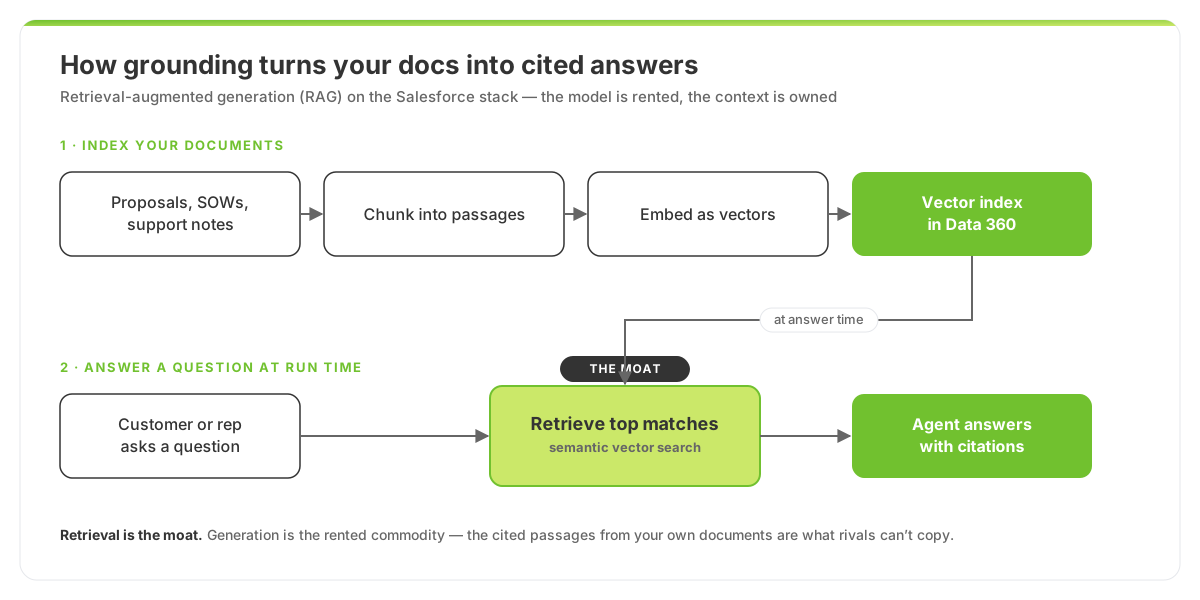 The RAG grounding pipeline: retrieval over your own documents is the moat; generation is the rented commodity.
Chunking, embeddings, and vector search: the 90-second version
- Chunking: Your 40-page SOW gets split into bite-sized passages, because retrieving one relevant paragraph beats dumping the whole document into the prompt.
- Embeddings: Each passage becomes a vector, a string of numbers that captures its meaning, not just its keywords. "Net payment terms" and "we invoice 30 days after milestone sign-off" land near each other even though they share no words.
- Vector search: When someone asks a question, the system finds the passages whose meaning sits closest to the question. This is semantic search. It understands intent, not just text matching.
- Grounded generation: The model writes its answer using those retrieved passages, and cites them.
In the Salesforce world, this is exactly what Data 360 (the platform formerly named Data Cloud) was rebuilt to do: index your structured and unstructured data so Agentforce can retrieve it at answer time. The rename from Data Cloud to Data 360 wasn't cosmetic; it signaled that grounding is now the whole point of the platform.
Why is your unstructured data the moat ChatGPT can't copy?
Because it's the one asset no foundation model has ever seen: years of proposals and support notes that encode which positioning wins and how your product actually fails, and that no rival can buy.
Roughly 80–90% of enterprise data is unstructured (documents, emails, PDFs, notes), not tidy rows in a database.
Most companies treat that as digital exhaust. I treat it as the crown jewels. Here's why: a competitor can copy your pricing page in an afternoon. They cannot copy ten years of proposals that encode which positioning closes deals in your niche, or a support archive that captures every weird failure mode your product has ever hit. That accumulated, written-down judgment is the thing the commodity model is missing, and the thing it's structurally impossible to buy.
| Ungrounded agent (generic AI) | Grounded agent (your data) | |
|---|---|---|
| Source of answers | Public internet, training data | Your proposals, SOWs, support notes |
| On your specifics | Plausible-sounding guesses | Accurate, cited to the source doc |
| Competitor can replicate? | Yes: same model, same week | No: it's your proprietary knowledge |
| Failure mode | Confidently wrong | "I don't have that documented" |
| Business value | A demo that impresses, then misleads | An expert that scales your best people |
That last row is the one that protects your P&L. An ungrounded agent's failure mode is confident misinformation to a customer. A well-grounded agent's failure mode is honest silence. It tells you when it doesn't know instead of inventing an answer. Which of those would you rather explain to a client?
How do you ground AI agents on company data without a data science team?
You curate and index your own documents on the Salesforce stack: inventory the gold, fix data readiness, ground one narrow use case, then index it in Data 360 and require citations. A configuration exercise, not a research project.
You do not need to hire ML engineers or stand up a vector database from scratch. On the Salesforce stack this is a configuration-and-curation exercise, not a research project. The sequence that actually works:
- Inventory your knowledge, not your fields. Find where the gold lives: the won-proposal folder, the SOW templates, the closed support cases with real resolution notes. This is a content audit, not a schema review.
- Fix readiness before retrieval. Garbage in, confident garbage out. Duplicate accounts, contradictory documents, and a stale knowledge base poison the well. This is exactly what a data readiness audit is for. It decides whether your agent helps customers or misinforms them.
- Pick a narrow, high-value first use case. Ground one agent on one corpus (say, RFP responses or tier-1 support deflection) and prove it. The Agentforce use cases that actually work for a 50-person company are narrow on purpose.
- Index in Data 360 and wire up retrieval. Connect the corpus, let the platform chunk and embed it, and point your agent at it. Zero-copy options can index data where it already lives instead of duplicating it, though zero-copy doesn't always save money, so check the math.
- Govern and cite. Require citations on every answer, set guardrails on what's retrievable, and route uncertainty to a human. The Einstein Trust Layer control checklist is the one-pager your board will ask for.
One non-negotiable: make citations mandatory. A grounded answer you can't trace back to a source document is just a hallucination with better manners. Citations are how you turn "trust me" into "check the SOW, page 12."
✅ Key Takeaways
- The model is a commodity; your context is the moat. Everyone rents the same brain. Your proprietary documents are the only durable differentiator.
- Grounding = retrieval before generation. The agent reads your relevant passages first, then answers. RAG's "retrieval" half is the part competitors can't copy.
- Unstructured data is the asset, not the exhaust. Proposals, SOWs, and support notes encode judgment no foundation model has ever seen.
- Readiness beats horsepower. A bigger model won't fix dirty, contradictory source documents. Clean the corpus first.
- Cited or it didn't happen. Require source citations so the failure mode is honest silence, not confident misinformation.
Frequently Asked Questions
What does it mean to "ground" an AI agent?
Grounding forces the agent to base its answer on your specific source documents rather than its general training. Before responding, it retrieves the most relevant passages from your proposals, SOWs, or support notes and answers from those, ideally with citations. The result is an agent that's accurate on your business, not just fluent in general.
Isn't this just uploading a few PDFs into ChatGPT?
For a one-off question, pasting a PDF works. As a business system, it doesn't scale or govern. Real grounding indexes thousands of documents, retrieves only the relevant slices per question, enforces permissions so reps don't see data they shouldn't, and logs citations for trust. It's the difference between a personal hack and an auditable, company-wide capability.
Do I need Data Cloud / Data 360 to do this?
Not strictly. RAG can be built on several stacks. But if you're already on Salesforce, Data 360 is the path of least resistance: it's purpose-built to index your data and feed Agentforce at answer time, inside your existing security and trust controls. The buy-versus-build math usually favors using what you already own over assembling a separate pipeline.
How do I stop it from leaking confidential data or making things up?
Three controls. First, scope retrieval to permission-aware data so the agent can only surface what the asking user is allowed to see. Second, require citations so every claim is traceable. Third, configure it to say "I don't have that documented" instead of guessing. Grounded correctly, the honest non-answer replaces the confident hallucination.
How long does this take to prove out?
A focused, single-corpus grounded agent can be piloted in weeks, not quarters, provided your source documents are clean. The long pole is almost never the AI; it's data readiness. Audit and tidy the corpus first, then grounding moves fast.
CTA: Turn your filing cabinet into your unfair advantage
Your competitors are all about to deploy the same model you can. The race isn't to the best AI. It's to whoever grounds it on the better knowledge first. The companies that win the next two years will be the ones that treated their proposals, SOWs, and support archives as a strategic asset instead of digital clutter.
That's the heart of our Transformation engagement at ODS ($29,997, fixed-price, ROI-guaranteed): we audit your unstructured data, ground a high-value Agentforce use case on it, and wire in the governance so it cites its sources and knows when to defer to a human. Not a science project. A working expert on your business, in weeks.
Two ways to start:
- Book a free Salesforce audit and we'll map exactly which of your documents are moat-grade and which need cleanup before they're safe to ground.
- Run the numbers on the ROI calculator, then compare the packages or talk to us directly about grounding your first agent.
Everyone gets the same brain. Let's give yours the memory only you own.

About the Author
Scott Ohlund
Certified Salesforce Architect with 13+ years of experience. Specialist in AI Agentforce, Data Cloud, and business automation solutions. As founder of Optimum Data Solutions, Scott helps SMB and mid-market teams cut Salesforce tech debt and ship AI-first CRM that actually moves revenue.
Ready to Transform Your Salesforce Experience?
Let's discuss your specific needs and create a customized solution that drives real results for your business.