Stop Calling It "Cleanup": How to Fund Salesforce Tech-Debt Remediation as an ROI Project Your CFO Will Actually Approve
TL;DR: Salesforce technical debt remediation ROI is real and calculable, but only if you stop pitching "cleanup." Reframe the debt as a liability accruing interest. Reclaimed admin hours, faster releases, and restored report trust are quantifiable returns, and remediation is the prerequisite that unblocks your stalled AI project. Phase it so early wins fund the rest.
Here is why your cleanup project dies every budget cycle: you keep calling it cleanup.
"Cleanup" sounds like cost with no return. It sounds like a chore. So it loses, every time, to anything with the word "revenue" attached. Meanwhile the debt sits there compounding, quietly taxing every report, every release, and every AI ambition you have.
The fix is not a better pitch. It is a better frame. Salesforce technical debt remediation ROI is not a soft, trust-me number. It is a return your CFO can underwrite, if you present it the way finance evaluates every other capital decision: as a liability carrying an interest rate, and a project that retires it. Here is the model I use to get these funded.
Is Salesforce tech debt a cost you defer or a liability accruing interest?
Tech debt is a liability that accrues interest every day you carry it, not a cost you can safely defer.
Most leaders treat tech debt like a messy garage. Annoying, but harmless to ignore one more quarter. That mental model is exactly why it never gets funded.
Here is the reframe. Tech debt is not a deferred cost. It is a liability on your books that accrues interest every single day you carry it. The interest shows up as admin hours burned on workarounds, releases that take three weeks instead of three days, and a pipeline report nobody trusts. So the VP rebuilds it by hand in a spreadsheet.
You are already paying that interest. You just never put it on a line item.
A CFO understands liabilities and interest instinctively. The moment you express debt in that language, the conversation flips from "why should we spend money cleaning up?" to "what is the carrying cost of not fixing this, and what does retiring it free up?" The second question funds projects. The first one never does.
What returns will a CFO actually underwrite for remediation?
Four: reclaimed admin and ops hours, faster release velocity, restored report trust, and the revenue project remediation unblocks.
Vague ROI gets cut. So we quantify four returns, each tied to a number the business already tracks. Plug in your own figures. The model matters more than my placeholders.
1. Reclaimed admin and ops hours
Every duplicate field, broken automation, and manual workaround costs human time. Sales ops re-keys data. Admins babysit flows that fail silently. RevOps reconciles two "sources of truth."
In our audits, a 150-person org typically loses roughly 15–25% of admin and RevOps capacity to debt-driven rework.
The math is simple: (fully-loaded hourly cost) × (hours/week lost) × 52. Two ops people at $55/hour losing 8 hours each per week is roughly $45,000 a year evaporating into workarounds. That is recurring. It compounds. And it is the most defensible number you have, because finance already knows those salaries.
2. Faster release velocity
When change sets break because the metadata is a minefield, every new request (a field, a flow, a report for the new product line) slows to a crawl. Faster releases mean revenue initiatives ship sooner. If a remediated org ships a pricing change two weeks earlier, that is two weeks of margin you would otherwise have left on the table. This is also where over-customization quietly bleeds you; I unpack that mechanism in why over-customizing builds the tech debt that sinks your next AI project.
3. Restored report trust
This one is invisible until you name it. When leaders do not trust the dashboard, they rebuild it manually, and worse, they decide on gut instead of data. Restoring a single trusted source of pipeline truth removes the shadow-spreadsheet tax and improves forecast accuracy. A 5-point improvement in forecast accuracy at a $20M company is not a rounding error.
4. The unblocked revenue project
This is the big one, and the reason remediation is not optional. Your stalled Agentforce or analytics rollout is not stalled because the AI is weak. It is stalled because it cannot run on a junk-data foundation. As I argued in why AI agent projects fail on data readiness, the AI almost never gets the blame it deserves. The org does. Remediation is the prerequisite that frees the revenue project sitting frozen behind it.
| Return | What you measure | Illustrative annual value |
|---|---|---|
| Reclaimed hours | Loaded ops cost × hours lost × 52 | ~$45,000 |
| Faster releases | Margin from initiatives shipping sooner | Varies; tie to one real deal |
| Restored report trust | Forecast accuracy + hours not spent rebuilding | ~$30,000 |
| Unblocked AI/revenue project | Value of the project that stays frozen | Often the largest line |
Notice the last row dwarfs the rest. Remediation's biggest return is rarely the cleanup itself. It is the six- or seven-figure initiative it sets free.
How do you phase remediation so the first win funds the next?
Run it in three phases (audit and quick wins, structural remediation, then data readiness) so each measurable result funds and de-risks the stage after it.
CFOs do not fear spending. They fear unbounded spending on something with no proof point. So you never ask for the whole remediation budget up front. You phase it, and you make the first phase self-funding.
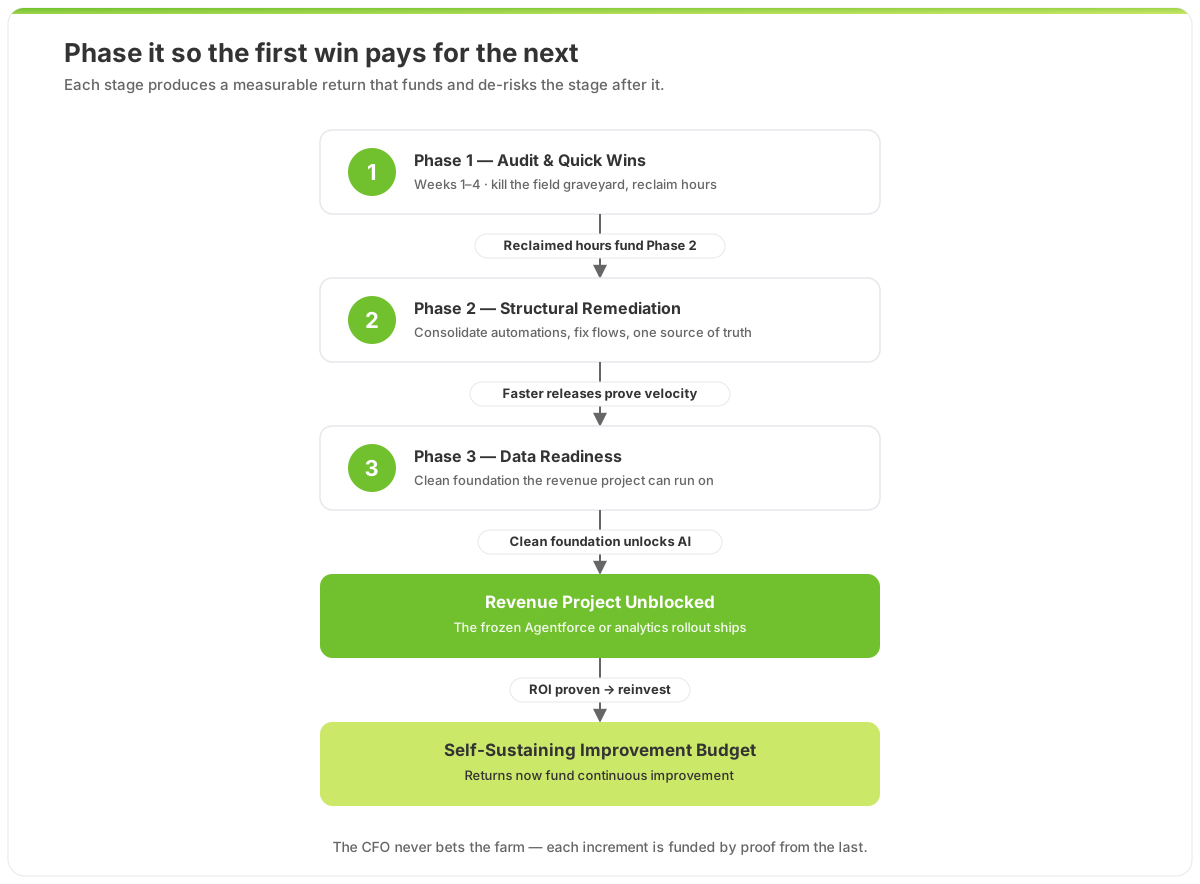 Phase the remediation so each measurable win funds and de-risks the next stage.
Phase 1: Audit and quick wins (weeks 1–4). Find the dead weight and kill the cheapest, highest-pain items first. The classic target is the field graveyard, the 300 dead fields quietly taxing every page load and every report. Quick wins reclaim hours immediately, and those reclaimed hours become the budget argument for Phase 2.
Phase 2: Structural remediation. Consolidate duplicate automations, fix the broken flows, collapse the competing sources of truth. This is where release velocity recovers.
Phase 3: Data readiness. Now the foundation can carry the revenue project. This phase pays for itself by unblocking the thing your board already wants, and you can pressure-test where you stand with the Agentforce readiness scorecard.
This phasing is the whole trick. Each stage produces a measurable result that justifies the next. The CFO is never asked to bet the farm, only to fund the next increment against proof from the last one. That is exactly how finance likes to deploy capital.
✅ Key Takeaways
- Stop saying "cleanup." Say liability accruing interest. It is the only frame that gets funded.
- Quantify four returns: reclaimed hours, faster releases, restored report trust, and the blocked revenue project.
- The biggest return is the unblocked initiative, not the tidiness.
- Phase the work so early wins fund later stages and de-risk the CFO's decision.
- The carrying cost is real and compounding. You are already paying interest, just off the books.
Frequently Asked Questions
How do I calculate the ROI of Salesforce technical debt remediation?
Quantify four returns and compare them to the carrying cost of doing nothing. Sum reclaimed admin hours (loaded rate × hours lost × 52), margin gained from faster releases, the value of restored report trust, and the revenue project remediation unblocks. Express the debt as a liability accruing interest. The blocked initiative is usually the single largest line.
Isn't this just maintenance we should absorb in the admin's salary?
No. Absorbing it is precisely how the interest compounds invisibly. Routine maintenance keeps the lights on; remediation retires accumulated principal that maintenance never touches. If your admin spends a quarter of their week on workarounds, that is not maintenance. It is debt service. Fund the remediation and you get that capacity back permanently.
How long before remediation pays back?
If you phase it correctly, Phase 1 quick wins reclaim hours within the first month, which funds the next stage. Most mid-market orgs see measurable hour-recovery in 30–60 days . The larger payback (the unblocked AI or analytics project) lands once data readiness is complete, typically one to two quarters in.
Should I remediate before or after buying Agentforce?
Before. Buying AI on top of a debt-laden org is how you fund a confident misinformation machine. A clean foundation is the difference between an agent that helps customers and one that hallucinates against bad data. Remediate first; the AI commit goes much further on a clean org. If budget is the sticking point, model the platform math in our 3-year Salesforce cost breakdown before you sign anything.
Who should own the business case, IT or finance?
RevOps or the COO should own it, with finance as co-author. Tech debt is a business liability, not an IT hobby. When finance helps build the model, it stops being "an IT ask" and becomes a capital decision the CFO already believes in. That co-ownership is what survives the budget cycle.
CTA: Turn your debt into a funded, board-ready business case
You do not have a cleanup problem. You have an unpriced liability that is quietly blocking your next revenue project, and a CFO who will fund its removal the moment you put real numbers on it.
That is exactly what our free Salesforce audit produces: a prioritized map of where the debt lives, what it is costing you in reclaimed-hour terms, and the phasing to retire it without breaking anything. Want the numbers first? Run your figures through the ROI calculator, then bring them to us.
For most mid-market orgs, this is our Growth package ($14,997): structural remediation that scales you without the chaos, phased so the first win helps fund the rest. If your org is actively on fire (releases failing, reports nobody trusts), start with the Emergency package ($4,997) and we stabilize before we strategize.
Stop letting "cleanup" lose the budget fight. Book the audit and we will hand you the CFO-ready case. We are the firm that has cleaned up dozens of these orgs, and turned the cleanup into the project that finally got approved.

About the Author
Scott Ohlund
Certified Salesforce Architect with 13+ years of experience. Specialist in AI Agentforce, Data Cloud, and business automation solutions. As founder of Optimum Data Solutions, Scott helps SMB and mid-market teams cut Salesforce tech debt and ship AI-first CRM that actually moves revenue.
Ready to Transform Your Salesforce Experience?
Let's discuss your specific needs and create a customized solution that drives real results for your business.