Salesforce's 80% AI Resolution Rate Is Completely Real, and Completely Useless to You
TL;DR: The 80% Agentforce resolution rate Salesforce shows on stage is real. But it was earned on a massive, professionally maintained knowledge base. Resolution rate is a downstream metric of content quality, not AI horsepower. On your messy help docs you'll land far lower. Fix the knowledge base, not the keynote number.
You've seen the slide. A confident "80%" in 200-point font, and the unspoken promise that you, too, are one signature away from deflecting four of every five support tickets. The Agentforce resolution rate Salesforce demos is not a lie. It's not even exaggerated. It's just measuring something you don't have yet, and the keynote never tells you what that something is.
Here's the reframe that should change how you evaluate this purchase: resolution rate is not a property of the AI. It's a property of your knowledge base. Salesforce's flagship number came from one of the cleanest, most heavily maintained support content libraries on the planet, running at enormous scale with full-time content engineers behind it. The model on top is the easy part. The 80% is the docs.
Buy Agentforce expecting 80% and you're not buying a result. You're buying a multiplier on whatever your help content already is. If a sharp human reading your current docs could only resolve 35% of tickets, the AI won't magically clear 80%. It'll clear something near 35%, then confidently make things up on the rest.
Why the keynote Agentforce resolution rate is real but non-transferable
The demo environment is Salesforce resolving questions about Salesforce. Sit with what that means:
- Thousands of articles, version-controlled and updated on every release.
- A taxonomy refined over years, so the retrieval layer almost never grabs the wrong doc.
- Enormous query volume, which means even the weird long-tail questions are still a large number of well-documented cases.
- Dedicated staff whose entire job is keeping that content accurate.
Your 60-person company has a Confluence space that three people edit, half of it written for a product version you sunset in 2023, and a "knowledge base" that's really a Slack channel and one heroic support rep named Dana. The AI is identical in both worlds. The inputs are not.
This is the exact trap I covered in why AI agent projects fail on data readiness: teams budget for the model and forget the model is only ever as good as the ground truth you feed it.
Which metrics actually govern Agentforce ROI?
Only one truly does: autonomous-resolution rate weighted by accuracy. Everything else is a supporting number or a vanity metric in disguise.
"Resolution rate" is a marketing wrapper around several distinct numbers, and the gap between them is where your money lives or dies. Insist on these definitions before anyone signs a consumption commit.
| Metric | What it actually measures | Why it matters to your P&L |
|---|---|---|
| Autonomous-resolution rate | Cases fully closed by the agent with no human touch | The only number tied to real labor savings |
| Deflection / containment rate | Cases that didn't reach a human, including abandons | Often inflated; a customer who rage-quits "counts" |
| Escalation rate | Share handed off to a person | Your true human-cost denominator |
| Accuracy / quality | Of resolved cases, how many were resolved correctly | A wrong answer "resolves" the ticket and creates two more |
Notice the trap. A vendor can quote a gorgeous "resolution rate" that's really a deflection rate padded with customers who gave up and closed the chat. That's not resolution. That's churn with a stopwatch on it. According to Gartner, most customers prefer self-service, until it fails them, after which their satisfaction drops below the no-AI baseline.
The number that pays your bills is autonomous-resolution rate, weighted by accuracy. Everything else is a vanity metric wearing a finance costume. For how those resolutions actually get billed, read our CFO-ready breakdown of Agentforce pricing.
What happens to the cases Agentforce can't resolve?
They're disproportionately your hardest, angriest, highest-stakes tickets, so what matters most is how cleanly the agent hands them to a human.
Now grant the best case. Say you do the work and hit a genuine, accurate 80% autonomous-resolution rate. Celebrate. Then look hard at the other 20%.
One in five customers still hits a wall. And it is not a random one in five. The questions an agent can't resolve are disproportionately the complex, high-stakes, already-frustrated ones: the billing dispute, the broken integration, the angry renewal. Your AI handles the easy volume beautifully and routes your hardest emotional moments to whatever human safety net you built, if you built one.
So the real question isn't "what's the resolution rate?" It's "what happens at the dead end, and how fast?" A clean handoff with full context can make 80% feel like 100%. A dead-end chatbot that loops the customer until they give up makes 80% feel like a betrayal.
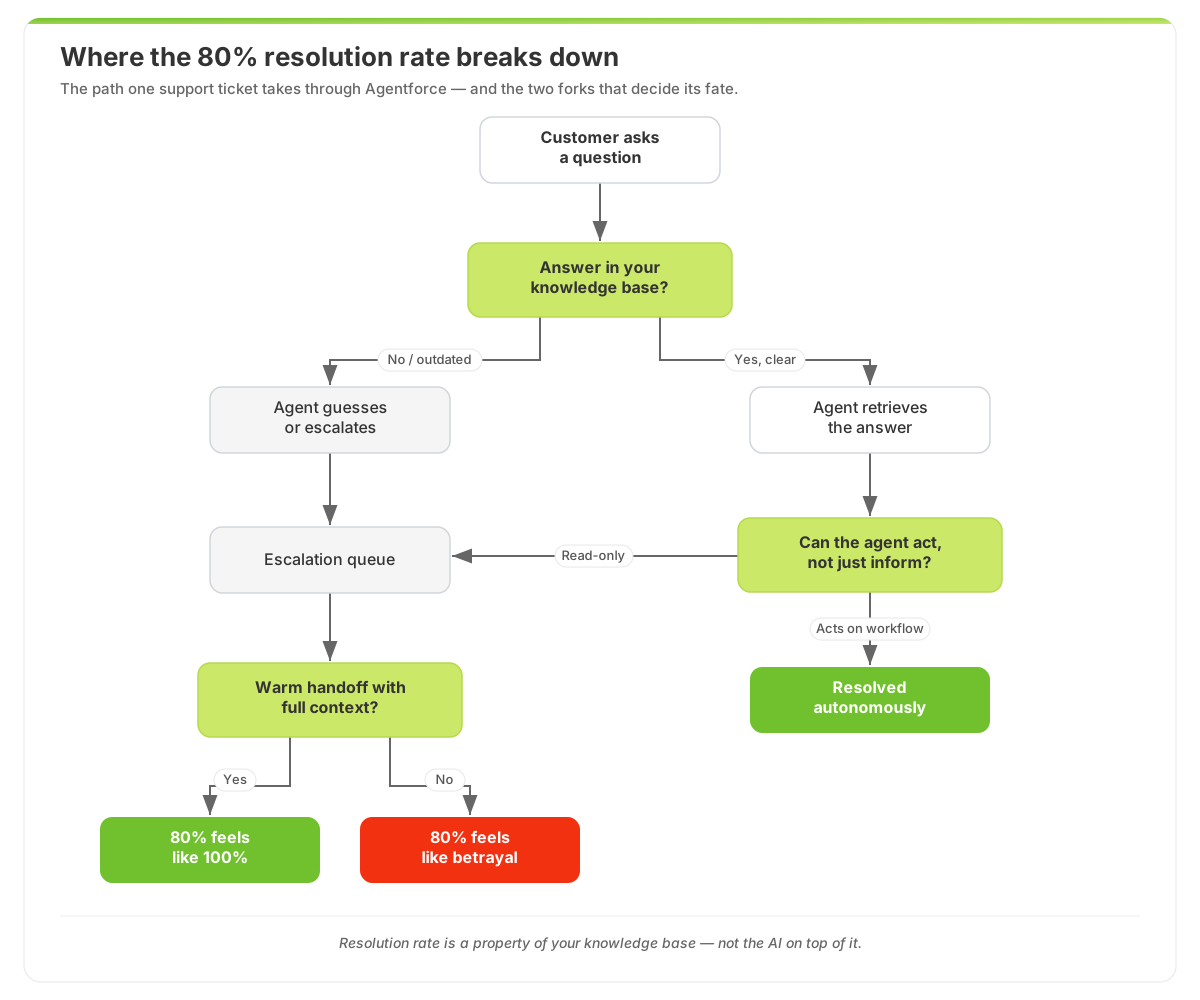 A ticket only counts as an autonomous resolution when your knowledge base is clear and the agent is wired to act. Otherwise the warm-handoff fork decides how the unresolved 20% feels.
That branch on the right ("act, not just inform") is the second hidden lever. An agent that can only quote a help article isn't resolving anything; it's a search box with manners. Real resolution requires the agent to be wired into a workflow it can execute: issue the refund, reset the access, reschedule the job. That's the grounding work covered in how to ground agents on your company data.
What Agentforce resolution rate should you actually expect?
It's set almost entirely by your knowledge base, not the AI. The cleaner and more current your help content, the higher your realistic ceiling.
Run honest math before you believe any projection. In our engagements, knowledge-base quality tends to map to autonomous-resolution rates roughly like this:
| Your knowledge-base reality | Realistic autonomous-resolution rate |
|---|---|
| Curated, current, structured, broad coverage | 70–85% |
| Decent docs, some gaps, light maintenance | 45–60% |
| Scattered docs, outdated, tribal knowledge | 20–35% |
| "It's in people's heads" | Don't deploy yet |
If you're in the bottom two rows, the highest-ROI move is not buying Agentforce. It's spending six weeks turning Dana's brain and your scattered PDFs into structured, accurate, retrievable content. Do that and your eventual resolution rate climbs for free, because, again, the rate lives in the docs. That cleanup is the same discipline behind a proper data readiness audit, and it's the cheapest performance upgrade you'll ever buy.
✅ Key Takeaways
- The 80% Agentforce resolution rate on the keynote slide is real but non-transferable. It reflects Salesforce's curated knowledge base, not the AI's raw ability.
- Resolution rate is a downstream metric of content quality. The lever the keynote never mentions is your knowledge base.
- Demand the breakdown: autonomous-resolution rate weighted by accuracy is the only number tied to ROI. Deflection padded with abandons is a vanity metric.
- Even a great rate strands your hardest, angriest 20%, so the warm-handoff path matters as much as the headline number.
- If your docs are scattered, fix the content first; the rate rises for free.
Frequently Asked Questions
What's a realistic Agentforce resolution rate for a small business?
For most SMBs starting out, expect 20–60% autonomous resolution, not 80%. The 80% figure reflects Salesforce's own enormous, professionally maintained knowledge base. Your realistic ceiling is set by how current, structured, and complete your help content is. Improve the content and the rate rises. The AI itself barely changes.
Is the 80% number from Salesforce fake or misleading?
It's neither fake nor a fair benchmark for you. The number is genuinely measured, but in an ideal environment: vast curated content, full-time maintenance, and massive query volume. Treating it as your expected result is the mistake. It's a best case, not an average.
What's the difference between resolution rate and deflection rate?
Resolution means the customer's issue was actually, correctly solved. Deflection just means they didn't reach a human, which includes people who gave up and abandoned the chat. Vendors sometimes report deflection as if it were resolution. Always ask for autonomous-resolution rate weighted by accuracy, plus your escalation rate, before trusting any projection.
How do I improve my Agentforce resolution rate?
Improve the knowledge base, not the prompts. Audit your help content for accuracy and coverage, restructure it for clean retrieval, retire outdated articles, and wire the agent into real workflows so it can act, not just inform. A two-week, low-cost Agentforce pilot will reveal your true starting rate before you commit a dollar.
Should I deploy Agentforce if my documentation is a mess?
Not yet. Deploying on bad content produces low resolution and confident wrong answers, the worst outcome, because a wrong answer "closes" a ticket and erodes trust. Fix the content first. It's the cheapest performance upgrade available and it raises your eventual resolution rate for free. See our take on the Agentforce use cases that actually work for a 50-person company.
CTA: Find Out Your Real Resolution Rate Before You Sign
Don't budget against Salesforce's 80%. Budget against yours. The number you'll actually hit is sitting in your help docs right now, and we can measure it before you commit to a single consumption credit.
ODS will benchmark your knowledge base, model your realistic autonomous-resolution rate, and map the warm-handoff path for the cases AI shouldn't touch, so you deploy with a number you can defend to your CFO. Start with a free, no-pitch Salesforce audit, or run the math yourself in our ROI calculator.
If you're ready to do it right, our Transformation package ($29,997, Agentforce + advanced automation) includes the knowledge-base remediation that makes the resolution rate real, backed by our 30-day milestone guarantee. Bring the messy docs. That's the whole point.
Scott Ohlund, Founder & Chief Salesforce Architect, ODS

About the Author
Scott Ohlund
Certified Salesforce Architect with 13+ years of experience. Specialist in AI Agentforce, Data Cloud, and business automation solutions. As founder of Optimum Data Solutions, Scott helps SMB and mid-market teams cut Salesforce tech debt and ship AI-first CRM that actually moves revenue.
Ready to Transform Your Salesforce Experience?
Let's discuss your specific needs and create a customized solution that drives real results for your business.