Decoding Agentforce Pricing: A CFO-Ready Model for Flex Credits, Pay-Per-Resolution, and the Token Trap
TL;DR: Agentforce pricing cost is metered by consumption, not by seat. Most SMBs pay roughly $2 per resolution or about $0.10 per action through Flex Credits. The catch: one customer interaction can fire several billable actions, so a chatty, document-heavy agent can cost 2–3x your forecast.
Salesforce has repriced Agentforce more than once since launch, and every time they do, the same email lands in my inbox: a founder forwards me a quote, a pricing page, and one question. "What is this actually going to cost me per month?" Nobody can answer it, because the unit being billed keeps changing. You cannot budget against a moving target.
So let's fix that. This guide turns every Agentforce pricing model into one defensible monthly forecast, the kind you hand your CFO without flinching. More importantly, it exposes the mechanic almost no buyer sees coming: the token threshold that quietly splits a single customer conversation into several billable actions. That is where the real Agentforce pricing cost hides, and it is why two companies running "the same" agent get bills that differ by 3x.
Why Is Agentforce Pricing Cost a Moving Target?
Here is the reframe, and it is the whole game: you are not buying software seats. You are buying machine labor by the unit. Traditional Salesforce pricing is a flat per-user license: predictable, boring, easy to forecast. Agentforce is metered, like an electric bill. The number on the invoice is a function of how much your agent does, not how many people you employ.
That single shift breaks every budgeting habit a mid-market buyer has. You stop asking "how many licenses?" and start asking "how many actions, at what unit price, with what cap?" Most teams never make that mental switch. That is exactly how they get surprised.
There have been roughly three pricing eras, and you may be quoted any of them:
| Model | What gets billed | Headline price | Best for | The hidden risk |
|---|---|---|---|---|
| Pay-per-resolution | Each resolved conversation | ~$2 per conversation | Predictable, high-volume Q&A | "Resolution" is defined by Salesforce, not you |
| Flex Credits (consumption) | Each agent action | ~$0.10 per action | Mixed or evolving workloads | Token splitting and runaway multi-step loops |
| Per-seat agent add-on | Internal user license | Flat monthly | Internal, employee-facing agents | Paying for seats nobody triggers |
The move toward Flex Credits matters most, because consumption is where SMBs get burned. With per-seat you overpay predictably. With consumption you can underpay until the month an agent goes chatty, and then the bill spikes with no warning. If you want the broader pattern behind Salesforce's shift away from seats, I covered it in Salesforce as your orchestration engine, not your destination.
What Is the Token Trap in Agentforce Pricing?
It's the mechanic where one customer conversation crosses a per-action token threshold and splits into several separately billed agent actions.
This is the part nobody prices for you, so read it twice.
A "billable action" is not the same as "a customer asking a question." Under the Flex Credits model, an action is a discrete step the agent takes: retrieve grounding data, reason over it, call an external system, generate a response. In our engagements, a single customer question routinely fires two to six of these.
Now add the multiplier. Each action carries a token threshold: a ceiling on how much text it can process before it splits into another billable action. Feed the agent a tidy FAQ answer and you stay under the line: one action, one charge. Feed it a 40-page SOW, a long email thread, or a sprawling knowledge article to ground its answer, and that single step crosses the threshold and splits into multiple billable actions.
That is why, in our experience, document-heavy agents typically cost 2–3x per interaction. It is not a bug. It is the meter doing exactly what it was designed to do.
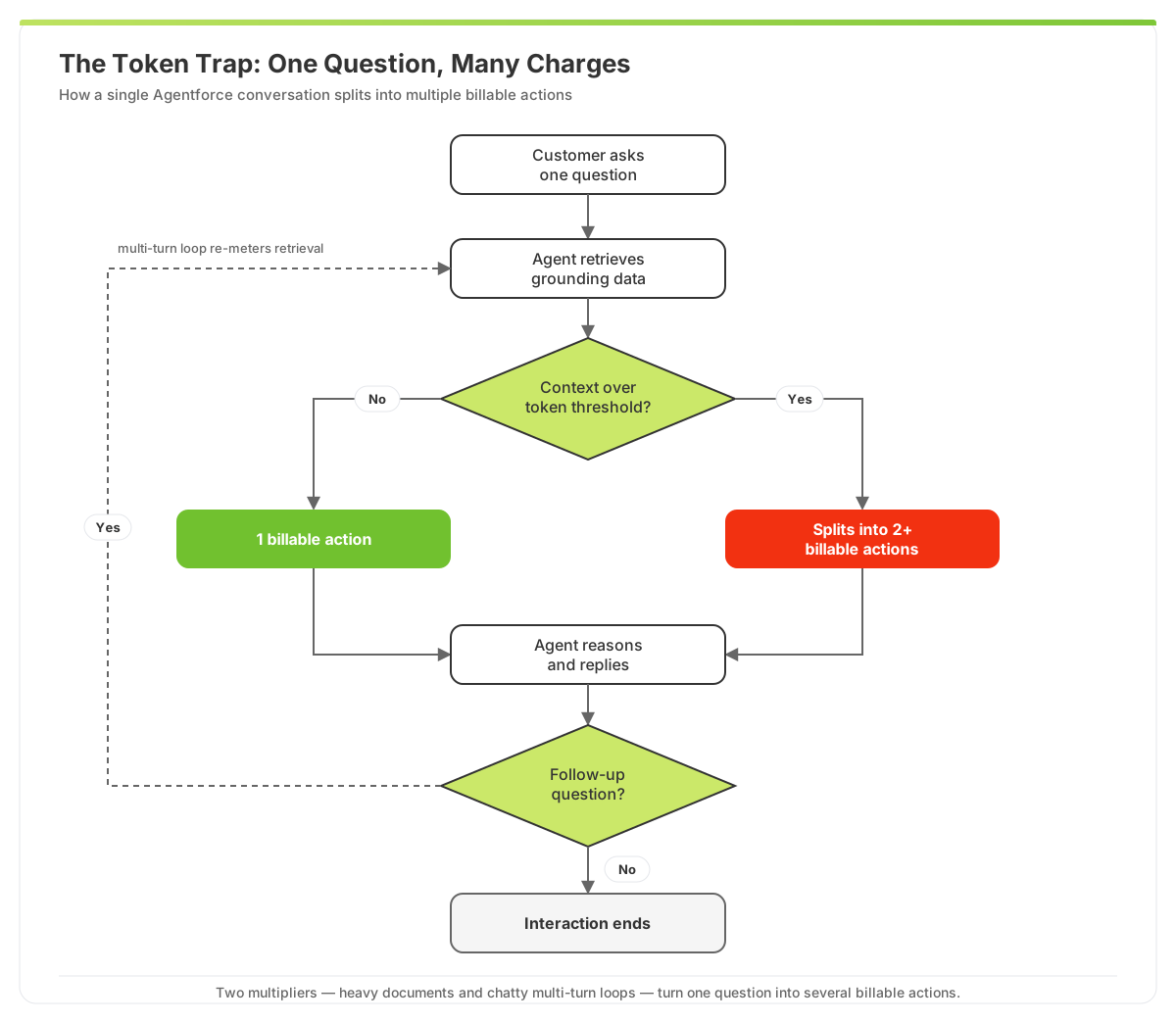 The token trap: under the threshold a question is one billable action, but heavy documents and chatty follow-ups split it into several.
Two forces stack here. Chattiness: multi-turn conversations loop back through retrieval and reasoning. And document weight: long grounding context splits each action. An agent answering "what are your hours?" is cheap. An agent reading a customer's contract to settle a billing dispute is not. Same license. Wildly different Agentforce pricing cost.
If you want to understand why grounding on your own documents is both your biggest competitive moat and your biggest cost driver, I broke it down in how to ground agents in your proposals, SOWs, and support notes.
One Defensible Monthly Forecast (Worked Math)
Let's make this concrete. Take a 50-person company running a customer-service agent at 2,000 conversations per month. Here is the same volume modeled as a lean agent versus a chatty, document-heavy one.
| Driver | Lean agent | Chatty, doc-heavy agent |
|---|---|---|
| Conversations / month | 2,000 | 2,000 |
| Billable actions per conversation | 2 | 6 |
| Total billable actions | 4,000 | 12,000 |
| Cost per action | $0.10 | $0.10 |
| Estimated monthly cost | ~$400 | ~$1,200 |
Same headline price. Same conversation count. 3x the bill. Driven entirely by design choices you control: how much you let the agent ramble, and how much raw document you stuff into each grounding call.
That is the forecasting discipline. Don't budget "2,000 conversations × unit price." Budget conversations × actions-per-conversation × unit price. Then pressure-test the actions-per-conversation number before you sign anything.
Spend Caps: The One Setting That Turns Anxiety Into a Budget
Consumption pricing has a built-in safety valve most buyers never configure: spend caps. You can set a hard ceiling on monthly consumption so a misbehaving agent (or a viral support spike) cannot run an open-ended tab.
Set the cap before go-live, not after the first scary invoice. A cap converts an unbounded liability into a fixed, defensible line item. That is the difference between "metered AI we control" and "a usage-based vendor with our credit card on file."
Before you commit to any consumption tier, run a real one. The 2-week, near-zero-cost Agentforce pilot exists precisely to measure your actual actions-per-conversation on your data, so your forecast is observed, not guessed.
How Does Agentforce Pay-Per-Resolution Pricing Work?
The per-resolution model sounds beautifully simple: you only pay when the agent solves something. But "resolution" is defined by the vendor, and the gap between a billed resolution and an actually solved problem is where the model gets slippery. An agent that confidently closes a ticket the customer reopens an hour later still counts as a resolution you paid for.
I unpacked why those celebrated resolution rates are real but nearly useless for budgeting in Salesforce's 80% AI resolution rate is completely real, and completely useless to you. The short version: model your cost on attempted interactions, not the vendor's success rate.
✅ Key Takeaways
- You're buying metered labor, not seats. Forecast actions, not headcount.
- One conversation ≠ one charge. Budget conversations × actions-per-conversation × unit price.
- The token threshold is the real cost driver. Long documents and chatty multi-turn flows split one step into several billable actions. That is the 2–3x.
- Set a spend cap before go-live. It turns an open-ended liability into a fixed line item.
- Pilot first. Measure your true actions-per-conversation on your own data before signing any consumption commit.
Frequently Asked Questions
How much does Agentforce actually cost per month for a small company?
For a 50-person company running ~2,000 service conversations monthly, plan on roughly $400–$1,200 per month depending on how document-heavy and chatty the agent is. The spread is real and driven by design, not vendor whim, so forecast the high end and engineer toward the low end.
What's the difference between Flex Credits and pay-per-resolution?
Flex Credits bill per action (each retrieval, reasoning step, or system call), so a complex interaction costs more than a simple one. Pay-per-resolution bills a flat amount per resolved conversation, regardless of effort. Flex Credits reward simple, well-scoped agents; pay-per-resolution rewards predictable, high-volume, low-complexity Q&A.
What is the "token trap" and how do I avoid it?
Each agent action has a token (text-volume) ceiling. When grounding context exceeds it, one action splits into several billable ones. Avoid it by trimming what you feed the agent: retrieve focused snippets instead of whole documents, cap conversation length, and design tight, single-purpose agents rather than do-everything ones.
Can I cap Agentforce spend so I don't get a surprise bill?
Yes. Configure a hard monthly spend cap before go-live. It bounds your maximum exposure and converts consumption anxiety into a fixed budget line. Pair it with usage alerting so you catch a spike on day three, not on the invoice.
Is Agentforce cheaper than hiring another rep?
Often, for tier-1 volume, but only if your data is clean enough that the agent resolves rather than escalates. A poorly grounded agent that escalates half its conversations costs you twice: the action spend and the human who finishes the job. The economics live in your data readiness, which is why we audit that first.
Stop Guessing at the Bill: Model It
You don't have a pricing problem. You have a forecasting problem. And that one is fixable in an afternoon with real numbers instead of a vendor's headline figure.
If you're weighing Agentforce, start with our free Salesforce audit: we measure your likely actions-per-conversation on your actual workflows and hand you a monthly forecast with the spend cap already sized. Want to sanity-check the math yourself first? Run the scenarios in our ROI calculator. And when you're ready to deploy an agent engineered to stay under the token threshold instead of blowing through it, that is the core of our Transformation package: fixed-price, with the cost model built in before a single credit is spent.
Don't sign a consumption commit against a number you can't defend. Talk to us, and walk in with a forecast your CFO will actually approve.

About the Author
Scott Ohlund
Certified Salesforce Architect with 13+ years of experience. Specialist in AI Agentforce, Data Cloud, and business automation solutions. As founder of Optimum Data Solutions, Scott helps SMB and mid-market teams cut Salesforce tech debt and ship AI-first CRM that actually moves revenue.
Ready to Transform Your Salesforce Experience?
Let's discuss your specific needs and create a customized solution that drives real results for your business.