When You Should Stay on HubSpot: From a Salesforce Architect Who Implements Both
TL;DR: In the HubSpot vs Salesforce for mid-market decision, most 10–500 person companies migrate about two years too early. Stay on HubSpot if your growth is marketing-led with a linear sales process. Move to Salesforce only when complex quoting, multi-entity structure, or AI agents on proprietary data make HubSpot the bottleneck, not before.
I sell Salesforce implementations for a living. So when I tell a prospect to stay on HubSpot, it costs me money. I do it several times a year anyway, because the alternative, taking a fee to migrate a company that didn't need migrating, is exactly how consultancies earn their bad reputation.
Here's what nobody pitching you a CRM will say out loud: the HubSpot vs Salesforce for mid-market question is almost never about which product is "better." Both are excellent. The real question is whether your revenue motion has outgrown HubSpot. For a surprising number of mid-market firms, it hasn't. They're being sold a forklift to move a backpack.
The reframe: you're not buying features, you're buying an inflection point
Most CRM comparisons line up feature checklists side by side. That's the wrong lens, and it's why so many migrations disappoint. Salesforce wins any feature bake-off because it can do nearly anything, and that is not a reason to buy it. A 737 has more capability than a pickup truck. You still don't fly one to the grocery store.
So here's the reframe: Salesforce isn't better than HubSpot. It's better at a specific inflection point, and if you haven't hit that point, the extra capability is pure cost with zero return. Every dollar of Salesforce power you're not using is a dollar of license, admin overhead, and complexity you're paying to carry.
That makes the only useful question this: have you actually hit the inflection point, or are you about to talk yourself into it?
The five signals you've genuinely outgrown HubSpot
These are the conditions where migrating earns its cost. You typically need two or more firing at once before the math works:
- Configure-Price-Quote complexity. Bundled products, usage tiers, approval matrices, multi-currency deals. HubSpot's quoting handles simple line items and buckles at real CPQ.
- Multi-entity or multi-org structure. Several business units, regions, or legal entities that need partitioned data, separate forecasting, and shared reporting on top.
- Deep, conditional automation. Logic that branches across objects and roles in ways that outrun HubSpot's workflow tooling.
- Territory, forecasting, and comp at scale. Complex hierarchies, quota rollups, and revenue forecasting that leadership runs the business on.
- AI agents grounded in your proprietary data. If your 18-month roadmap includes Agentforce reasoning over your SOWs, support history, and contracts, you want the data architecture Salesforce is building toward. (More on that in why most AI agent projects fail on data readiness.)
If none of these are true today and only one is "maybe, eventually," stay put. Revisit in twelve months. Migrating ahead of need just means paying for capability that sits idle while your team relearns where the buttons are.
The decision tree I actually use
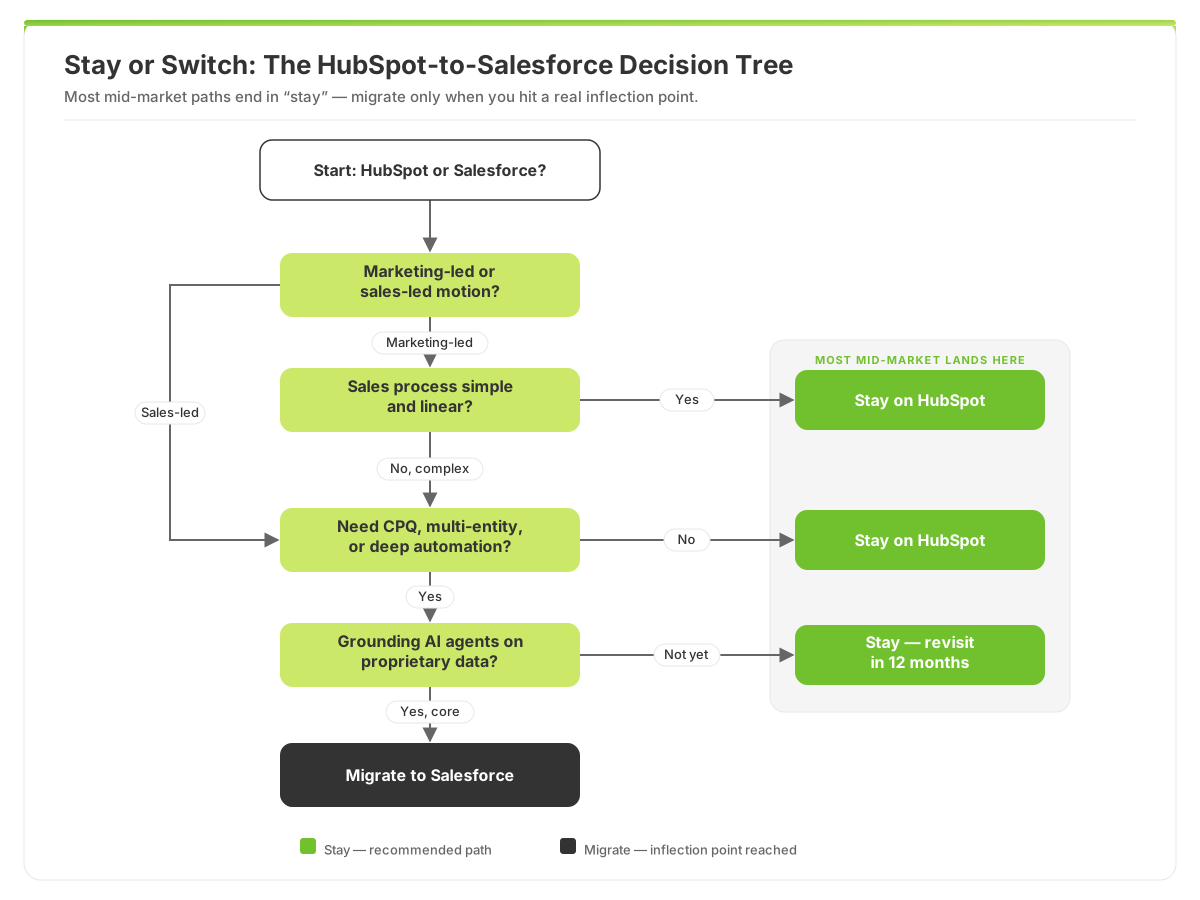 The stay-or-switch decision tree: notice how many paths end in "stay." That's the honest distribution of a mid-market book of business.
Notice how many paths end in "stay." That's not me being soft on Salesforce. That's the honest distribution of a mid-market book of business.
What does HubSpot vs Salesforce really cost?
The honest answer: per-seat pricing barely differs between the two. Implementation and ongoing admin are what decide the real cost.
Here's where buyers get burned: they compare sticker prices and ignore the real cost line, which is everything wrapped around the license. Run the full picture in both directions and the gap looks nothing like the per-seat numbers.
| Cost line (25 seats) | HubSpot Sales Hub Enterprise | Salesforce Sales Cloud Enterprise |
|---|---|---|
| Per-seat license | ~$150/user/mo | ~$165/user/mo |
| Annual license (25 seats) | ~$45,000 | ~$49,500 |
| Implementation (one-time) | $5k–$25k | $30k–$150k+ |
| Ongoing administration | Fractional admin | 0.5–1 FTE admin or partner retainer |
| Realistic time to value | Weeks | 2–4 months |
The license delta is almost a rounding error. The migration and ongoing-admin lines are where the money actually lives. And they're the exact lines a sales rep glosses over. For the full version of this math across company sizes, see the honest 3-year cost of Salesforce for a company your size.
Now run it the other direction. A genuine inflection-point company that clings to HubSpot pays a different tax: deals lost to clumsy quoting, RevOps duct-taping spreadsheets onto a tool that can't model the business, leadership flying blind on forecast. Staying too long is just as expensive as switching too early. The discipline is matching the architecture to the complexity you actually have, not the ambition you're pitching your board. That's the same trap I unpack in the native vs. headless mid-market decision tree.
When should you stay on HubSpot?
Stay on HubSpot when your growth is marketing-led, your sales process is linear, and none of the five inflection-point signals have fired.
Stay if most of these describe you:
- Your growth is inbound and marketing-led, and HubSpot's marketing engine is doing real work you'd have to rebuild or rebuy on the Salesforce side.
- Your sales process is linear: a handful of stages, simple quotes, no approval gymnastics.
- Your ops team is small, and you don't want to fund a Salesforce admin or a partner retainer just to keep the lights on.
- You're tempted to migrate mostly because Salesforce is "what serious companies use." That's status anxiety, not a business case.
That last one matters more than people admit. "We felt like we should be on Salesforce" is the single most expensive sentence in mid-market CRM. By most industry measures, Salesforce holds the largest share of the global CRM market . Market share is a reason vendors win deals. It is not a reason your business needs the platform.
When should you migrate to Salesforce?
Move when the inflection-point signals are real and present, when HubSpot has become the constraint your revenue team works around rather than with. At that stage the migration cost stops being overhead and starts paying for itself: faster quoting, a real forecast, a data foundation your AI roadmap can actually stand on.
One caution from cleaning up dozens of these orgs: if you migrate, resist the urge to recreate every clever workflow you've ever accumulated. That's how you import yesterday's mess into a more expensive tool. I've watched companies port years of HubSpot cruft straight into Salesforce and manufacture instant technical debt, exactly the kind that sinks the next AI project. Migrate the motion, not the mess.
✅ Key Takeaways
- The HubSpot vs Salesforce for mid-market choice is about an inflection point, not a feature checklist. Unused capability is pure cost.
- You usually need two or more of the five signals (CPQ, multi-entity, deep automation, complex forecasting, AI-on-proprietary-data) before migrating pays off.
- Compare full TCO, not sticker price. Implementation and admin dwarf the license delta.
- Run the math both ways: switching too early and staying too long are both real, expensive taxes.
- "Serious companies use Salesforce" is status anxiety, not a business case. Don't migrate on vibes.
Frequently Asked Questions
Is HubSpot good enough for a mid-market company, or will we outgrow it?
HubSpot comfortably supports many companies well into the mid-market, especially marketing-led ones with straightforward sales processes. You "outgrow" it not at a headcount number but at a complexity threshold: real CPQ, multi-entity structure, or AI agents on proprietary data. Plenty of 200-person firms run beautifully on HubSpot. Plenty of 40-person firms genuinely need Salesforce. Complexity, not size, is the trigger.
How much does it really cost to migrate from HubSpot to Salesforce?
Expect the license delta to be minor and the surrounding costs to dominate. Implementation for a mid-market migration commonly lands in the $30k–$150k range , plus ongoing administration of roughly half to one full-time equivalent. Budget two to four months to real value. Run our ROI calculator before committing to put hard numbers against your own situation.
What's the biggest mistake companies make in the HubSpot vs Salesforce decision?
Migrating too early, on prestige rather than need, then importing every accumulated HubSpot workflow into Salesforce and recreating the chaos in a costlier tool. The second-biggest mistake is the opposite: staying so long that clumsy quoting and spreadsheet-driven RevOps quietly cost more than a migration would have. Both come from skipping an honest, bidirectional cost analysis.
Can we run AI agents on HubSpot, or do we need Salesforce for that?
HubSpot has its own AI features, and for many use cases they're sufficient. The distinction is depth. If your roadmap requires agents reasoning over proprietary, unstructured data (proposals, SOWs, support notes) with enterprise-grade governance, Salesforce's data-and-trust architecture is purpose-built for it. If that's not on your near-term roadmap, it is not a reason to switch today.
We're growing fast. Shouldn't we move to Salesforce now to avoid migrating later?
Pre-emptive migration is the most common way mid-market teams burn budget. You pay for idle capability, admin overhead, and retraining months or years before the complexity that justifies them arrives. A clean HubSpot-to-Salesforce migration is very doable later, once a signal actually fires. Buy the architecture for the business you have, not the one on a slide.
Get a straight answer before you spend a dollar
You don't need a vendor's opinion on the HubSpot vs Salesforce for mid-market question. You need someone who profits either way to look at your actual revenue motion and tell you the truth, including "stay where you are."
That's exactly what a free Salesforce audit is for. We'll map your five signals, run the bidirectional TCO against your real numbers, and tell you whether migrating earns its cost or whether you should reinvest that budget elsewhere. If the answer is "migrate," our fixed-price Growth package gets you onto Salesforce without recreating the mess: scale, not chaos. If the answer is "stay," you walk away with a documented framework for revisiting the call in twelve months.
Either way you leave with clarity instead of a sales pitch. Book the audit, or tell us what you're wrestling with and we'll point you at the honest answer.

About the Author
Scott Ohlund
Certified Salesforce Architect with 13+ years of experience. Specialist in AI Agentforce, Data Cloud, and business automation solutions. As founder of Optimum Data Solutions, Scott helps SMB and mid-market teams cut Salesforce tech debt and ship AI-first CRM that actually moves revenue.
Ready to Transform Your Salesforce Experience?
Let's discuss your specific needs and create a customized solution that drives real results for your business.