Native, MuleSoft, or Headless? A Mid-Market Decision Tree for Matching Architecture to Complexity, Not Ambition
TL;DR: In the composable architecture vs native Salesforce decision, most SMBs should stay native until native genuinely can't do the job, add MuleSoft only when four or more systems must act on each other in real time, and go fully composable last. Do that only if they have a team to run the upkeep. Match architecture to complexity, not ambition.
Here's the trap, and almost every mid-market company walks into it the same way.
A vendor (or a slick "modern architecture" blog post) shows you a beautiful diagram. Salesforce in the middle. MuleSoft as the nervous system. A headless front end. Everything composable, swappable, future-proof. It looks like maturity. It looks like what the big logos do. So a 70-person company signs up for a platform stack designed for a 7,000-person company, and spends the next two years paying for, and tripping over, integration plumbing it touches twice a quarter.
The question was never "which architecture is most advanced?" It's "which problem do I actually have?" That's the part the listicles can't answer for you. So let's draw the line they won't.
The reframe that prevents most over-buying
This is the single distinction that settles the composable architecture vs native Salesforce question for an SMB. Get it right and you stop confusing two completely different problems that vendors love to bundle into one invoice.
Zero-Copy / Data 360 answers a question about where the data lives. It lets Salesforce read and act on data sitting in Snowflake, BigQuery, or Databricks without physically copying it in. It's a location answer: "I need a 360 view and reporting across systems, but I don't need to move the data."
MuleSoft answers a question about how systems act on each other. It's an orchestration and API answer: "When a deal closes in Salesforce, provision the account in billing, kick off onboarding in ops, and sync the result back. Reliably, every time, at volume."
Those are not the same problem. Confusing them is exactly how companies overspend.
If your real need is "one trustworthy view of the customer across tools," you may need federation, not an integration platform. If your real need is "five systems must trigger and update each other without humans copy-pasting," that's orchestration. That's where MuleSoft earns its keep. We unpack the data-location side in our breakdown of when Zero-Copy actually saves money; this post is about the acting-on-each-other side, and where the line sits.
The aha: Most "we need MuleSoft" conversations are actually "we need a 360 view" conversations wearing a more expensive costume. Diagnose the question before you buy the answer.
The mid-market maturity model
Picture four levels. The goal is to operate at the lowest level that solves your actual problem, not the highest level you can imagine wanting someday.
| Level | What it looks like | When it's right | The real cost driver |
|---|---|---|---|
| 1. Native | Flow, standard connectors, clicks-not-code | One CRM, a handful of point integrations | Admin time |
| 2. Native + Zero-Copy | Salesforce reads warehouse data in place (Data 360) | You need a 360 view / cross-system reporting | Query/compute, not headcount |
| 3. MuleSoft orchestration | API-led integration, many systems acting in real time | 4+ systems with two-way, high-volume, business-critical flows | Platform license + the team to run it |
| 4. Full composable / headless | Decoupled front end, swappable services | True multi-channel scale, dedicated platform team | Ongoing multi-vendor upkeep |
The mistake isn't picking the wrong level. It's skipping levels: jumping from a messy native org straight to Level 4 because the architecture diagram looked impressive in the pitch.
How do you choose between native, MuleSoft, and headless Salesforce?
Start native and stay there until it genuinely can't do the job, add Zero-Copy when the question is where the data lives, bring in MuleSoft only when four or more systems must act on each other in real time, and go fully composable last. Go there only with a team to own the upkeep.
Run your need through this before anyone shows you a quote.
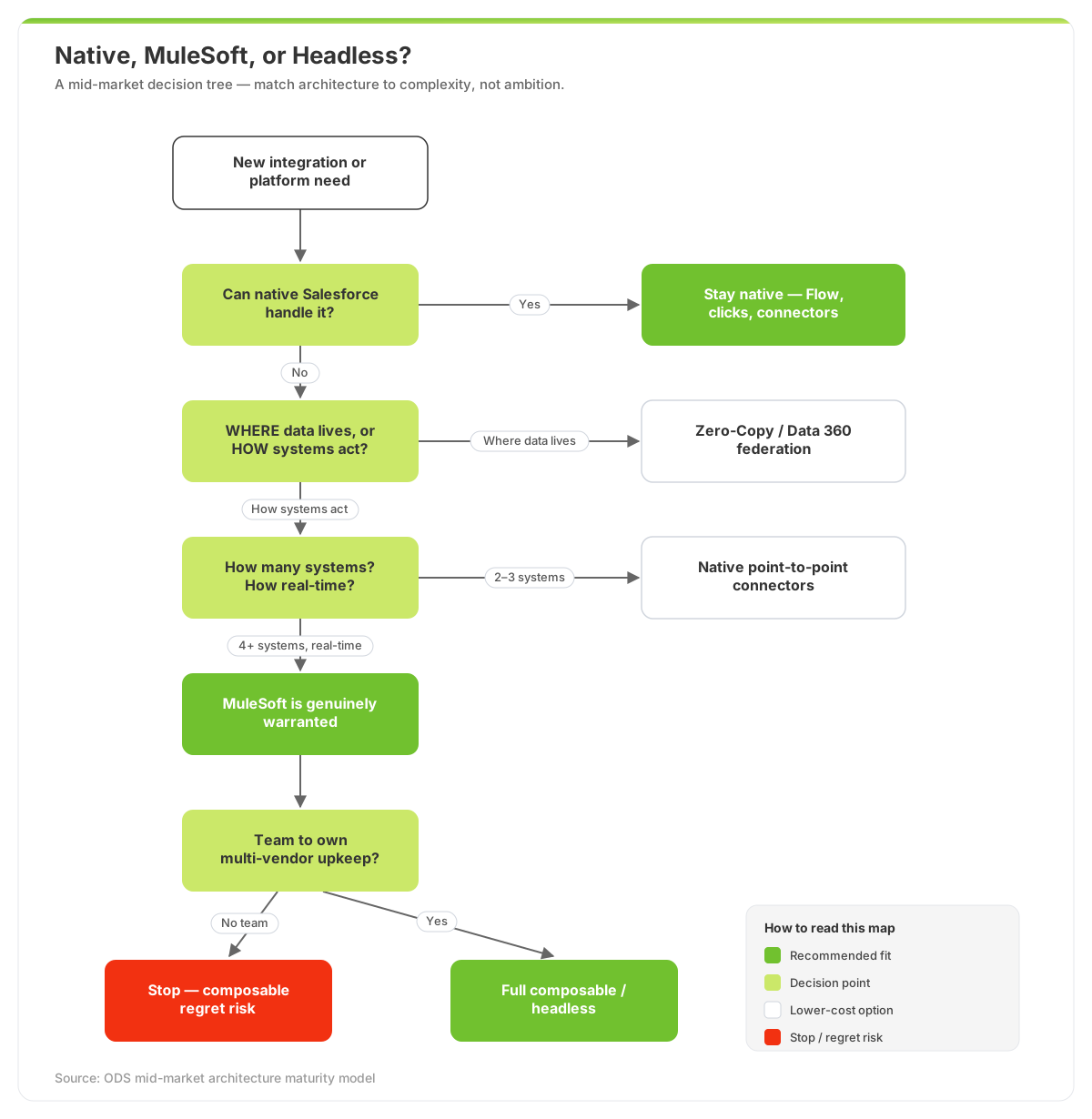 Match the architecture to the problem you can prove: stay native until it genuinely can't do the job, and treat operational capacity as the real gate for MuleSoft and headless.
Notice the last gate. The deciding factor isn't technical capability. MuleSoft and headless can absolutely do the job. It's whether you have the operational capacity to own what you're buying. That's the question vendors never ask, because the honest answer often loses them the deal.
What is "composable regret"?
"Composable regret" is the morning-after feeling when a company realizes the swappable, best-of-breed stack it bought now requires a standing team to keep alive. Gartner and other analysts have repeatedly flagged that organizations underestimate the integration and maintenance cost of composability: the upkeep, not the build.
Here's the math that gets skipped. Composable isn't "Salesforce plus MuleSoft." It's:
- MuleSoft licensing (six figures annually is common at any real volume)
- Integration engineers who can maintain it
- Version upgrades across every connected vendor
- Monitoring and on-call discipline for when a flow silently breaks at 2 a.m.
A 50-person company rarely has the third and fourth items. So the platform that was supposed to create agility creates a new dependency, and a permanent line item. It's the same pattern we see with over-customization: teams build sophistication they then have to feed forever. We covered that failure mode in Stop Over-Customizing Salesforce, and composability is its architecture-level cousin.
Quotable rule of thumb: MuleSoft is warranted when the cost of systems not talking to each other (manual rework, errors, delays) clearly exceeds the cost of running the integration platform. If you can't draw that line on a napkin, you're not there yet.
What does each architecture level cost?
Cost climbs at every level: admin time only when you stay native, modest compute for Zero-Copy, a platform license plus an integration owner for MuleSoft, and a full stack plus a standing team once you go composable.
Translate the levels into spend, and the case for restraint gets obvious.
| Scenario | Right architecture | Rough annual posture |
|---|---|---|
| 40-person services firm: CRM + accounting + email | Native (Level 1) | Admin time only |
| 120-person firm needing cross-system reporting | Native + Zero-Copy (Level 2) | Modest compute/query spend |
| 250-person firm: real-time order/billing/ops sync | MuleSoft (Level 3) | Platform license + integration owner |
| Multi-brand, multi-channel, dedicated platform team | Composable (Level 4) | Full stack + standing team |
Most companies that think they're in row three are actually in row two. The honest move is to size the architecture to the complexity you can prove, not the ambition you can imagine. If you're weighing whether a headless approach even applies to a company your size, start with Headless 360 explained for a 50-person company. And brace for the uncomfortable part: headless exposes every mess you've been ignoring before it delivers a thing.
✅ Key Takeaways
- Diagnose the question first. Zero-Copy answers where the data lives; MuleSoft answers how systems act on each other. They are not interchangeable.
- Operate at the lowest level that solves your real problem, not the highest level you can picture wanting someday.
- The deciding gate for MuleSoft and headless is operational capacity (do you have a team to run it?), not technical capability.
- Composable regret is an upkeep cost, not a build cost. Multi-vendor maintenance is the line item nobody quotes you.
- If you can't draw the ROI line on a napkin, you're not ready for composable. Stay native and revisit when the math changes.
Frequently Asked Questions
When does an SMB genuinely need MuleSoft instead of native Salesforce?
When four or more systems must act on each other in real time, the flows are business-critical, and the volume is high enough that point-to-point integrations become brittle. With two or three systems and modest volume, native connectors or a lightweight integration tool will almost always be cheaper and just as reliable. MuleSoft is justified by orchestration complexity, not by company prestige.
Is composable architecture better than native Salesforce for an SMB?
Not inherently. "Better" depends entirely on your complexity and your operating capacity. Composable buys flexibility and swappability at the price of permanent multi-vendor maintenance. For most SMBs, native Salesforce plus selective federation delivers the same outcome at a fraction of the upkeep. Composable becomes "better" only when you have the scale and the team to absorb its ongoing cost.
What's the difference between Zero-Copy and MuleSoft?
Zero-Copy (part of Data 360) answers where data lives: it lets Salesforce read and act on warehouse data without copying it in, ideal for unified reporting and a 360 view. MuleSoft answers how systems act on each other: orchestrating real-time, two-way transactions across applications. One is about visibility; the other is about action. Many teams buy MuleSoft when federation was the actual need.
How do I avoid "composable regret"?
Size the architecture to complexity you can prove, not ambition you can imagine. Before signing any platform commit, write down the standing cost: licensing, integration engineers, version upgrades, and monitoring. If your team can't realistically own all four, stay at a lower maturity level and revisit when the business case is undeniable. A free architecture audit is the cheapest way to pressure-test the decision.
Can I start native and move to composable later?
Yes, and you usually should. A clean, well-modeled native org is the foundation that makes a later move to MuleSoft or headless cheap and safe. The companies that struggle are the ones that bolted composability onto a messy org. Get the data model and processes right first; the architecture decision gets easier and lower-risk every quarter you do.
Match the architecture to your reality, before you sign the commit
The worst integration decisions aren't made by engineers. They're made in a vendor demo, by a buyer who couldn't yet tell a where problem from a how problem, and signed for the most advanced thing in the room.
That's the exact judgment call ODS exists to make with you. In a free Salesforce architecture audit, we run your actual systems through the decision tree above and tell you the truth: stay native, add federation, or (only if the math genuinely supports it) bring in MuleSoft. We earn no commission for steering you into a platform you don't need.
If the audit confirms you're ready to scale without bolting on chaos, our fixed-price Growth engagement ($14,997) is built precisely for the Level 2–3 jump: get the data model and orchestration right, sized to the complexity you can prove. Want to see the spend difference before you talk to anyone? Run the numbers in our ROI calculator, then book a conversation.
Buy the answer to the problem you have. Not the one in the diagram.

About the Author
Scott Ohlund
Certified Salesforce Architect with 13+ years of experience. Specialist in AI Agentforce, Data Cloud, and business automation solutions. As founder of Optimum Data Solutions, Scott helps SMB and mid-market teams cut Salesforce tech debt and ship AI-first CRM that actually moves revenue.
Ready to Transform Your Salesforce Experience?
Let's discuss your specific needs and create a customized solution that drives real results for your business.