The One-Page AI Control Checklist Your Board Will Ask For: The Einstein Trust Layer in Plain English
TL;DR: An AI agent governance checklist is one page that answers two board questions: what can our AI say and do, and how do we prove it? Salesforce's Einstein Trust Layer supplies the controls: PII masking, dynamic grounding, zero data retention, toxicity detection, an audit trail, and human escalation. You supply the policy behind each one.
Here is the conversation that quietly kills most customer-facing AI projects. You're three weeks from launching an Agentforce agent that will talk to real customers. Someone on your board, or your insurer, or your biggest account's security team, asks a five-word question: "How do we control it?"
If you can't answer that on one page, the launch slips. Not because the technology isn't ready, but because nobody translated it into governance a non-engineer can sign their name under. This post hands you that page. An AI agent governance checklist is not a 40-tab risk register. It's a single control sheet that maps each safety feature to the question it answers and the evidence that proves it's on.
Does an AI agent add new risk, or just inherit the risk you already have?
It inherits yours: an AI agent magnifies the governance and data discipline you already have rather than creating exotic new risks.
Here's the aha that changes the whole conversation. Most owners walk into AI governance braced for exotic new dangers: a robot inventing lies, leaking secrets, going rogue. That framing is wrong, and it makes you defensive about the wrong things.
An AI agent inherits the governance you already have. Point it at clean, permissioned data with clear policies, and it behaves. Point it at a messy org with 300 dead fields and no access controls, and it confidently surfaces garbage, faster and more politely than any human ever could. The agent isn't the risk. The agent is a magnifying glass held over your existing data and process discipline.
That reframe tells you where the real work is. The Einstein Trust Layer hands you a set of switches. But a switch only protects what your policy and data already define. This is the same reason AI agent projects fail on data readiness, not on the AI itself. The model is rarely the weak link.
So the checklist has two halves: the controls Salesforce gives you, and the policy you have to bring. Let's make both concrete.
What goes on a one-page AI control sheet?
This is the table to hand your board. Each row is a named Einstein Trust Layer feature in plain English, the question it answers, and the artifact that proves it's working.
| Control (Trust Layer feature) | What it actually does | The board/auditor question it answers | How you prove it |
|---|---|---|---|
| PII / data masking | Strips names, emails, card and account numbers from the prompt before it reaches the model | "Does customer PII leave our walls?" | Masking config + a sample masked prompt log |
| Dynamic grounding | Forces answers from approved, permissioned records only, not the model's open-web guesses | "Where does the answer come from?" | The grounded source list + field-level security rules |
| Zero data retention | The model vendor does not store or train on your prompts and responses | "Is our data training someone else's AI?" | Salesforce's contractual ZDR terms with model providers |
| Toxicity detection | Scores every response and blocks harmful, biased, or abusive output | "Can it say something that embarrasses us?" | Toxicity threshold settings + blocked-response logs |
| Audit trail | Logs every prompt, every data source touched, every action taken | "Can we reconstruct what it did and why?" | Exportable audit log (Event Monitoring) for any interaction |
| Human escalation | Hands off to a person when confidence is low or the topic is out of scope | "What happens when it doesn't know?" | Escalation rules + a sample handed-off transcript |
Six rows. Every one maps a scary unknown to a switch you can turn on and a document you can produce. That is the entire job.
How a single customer question flows through the controls
The features aren't a menu you pick from. They fire in sequence on every interaction. Show your board this and the abstract becomes obvious.
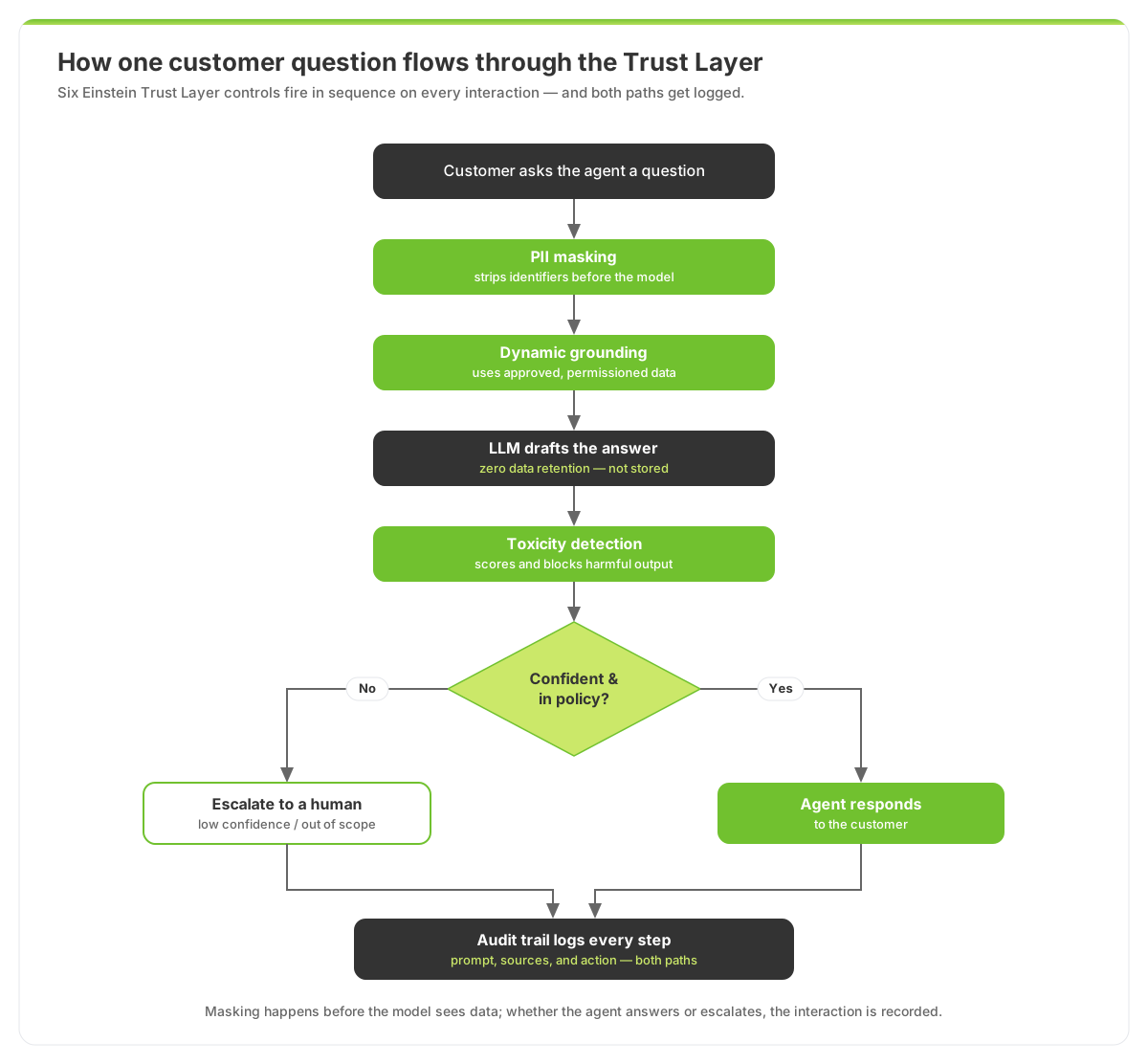 Every customer question runs the same Einstein Trust Layer sequence, and both the answered and escalated paths land in the audit log.
Notice the masking happens before the model sees anything, and the audit log captures both paths. Those two details answer the two questions security reviewers ask most.
What does the Trust Layer cover, and what stays your job?
The Trust Layer handles masking, grounding, toxicity blocking, logging, and escalation in transit; you still define what's sensitive, whether your permissions are correct, what's in scope, and who reviews the logs.
This is the second half of the checklist, and the half consultants love to skip because it's the unglamorous part. The Trust Layer is a strong floor. It is not a ceiling, and it is not a substitute for your own decisions.
| The Trust Layer handles | You still have to define |
|---|---|
| Masking PII in transit | Which fields count as sensitive in your business |
| Grounding on permissioned data | Whether your permissions are actually correct |
| Blocking toxic output | What "off-topic" or "out of scope" means for your brand |
| Logging every action | Who reviews the logs, and how often |
| Offering escalation | Who the human on the other end actually is |
Read that right column again. Every item is a policy decision, not a feature toggle. This is why Salesforce's own retreat from fully autonomous agents, which I covered in why walking back autonomous AI is good news for cautious SMBs, is a gift. The platform now assumes a human owns the boundaries. Your checklist is where you write them down.
According to Gartner, a majority of organizations deploying generative AI will hit governance or compliance friction through 2026 largely because controls were never documented, not because they were never available. The tooling is rarely the gap. The one-pager is the gap.
How to actually fill this out before go-live
Don't theorize. Run the sheet against one real use case. Here's the sequence I use with clients deploying their first customer-facing agent:
- Pick one narrow agent: say, an order-status assistant. Scope decides risk. (The Agentforce Readiness Scorecard helps you size this honestly.)
- Walk each row top to bottom. Turn the control on, then produce the proof artifact now, not later. If you can't produce it, the agent isn't ready.
- Sign the right column. Name a human owner for masking definitions, permission accuracy, log review, and escalation routing. Unowned controls are decorative.
- Dry-run 20 hostile prompts. Try to make it leak, lie, and offend. Save the transcripts. That's your strongest board evidence.
- Date it. Governance is a snapshot. Re-sign the sheet every quarter or after any major data or permission change.
A first pass takes a focused afternoon, not a quarter. The output is a document your CFO, your board, and a customer's security team all read the same way.
✅ Key Takeaways
- AI doesn't invent new risk. It inherits and magnifies the governance and data discipline you already have.
- The Einstein Trust Layer ships six controllable safety features: PII masking, dynamic grounding, zero data retention, toxicity detection, audit trail, and escalation.
- Your AI agent governance checklist is one page: each control mapped to the question it answers and the artifact that proves it.
- The Trust Layer is a floor, not a ceiling: the policy decisions in the right-hand column are yours to make and own.
- Don't launch a customer-facing agent until every row has a turned-on control and a produced proof artifact.
Frequently Asked Questions
Is the Einstein Trust Layer enough to pass a SOC 2 or security review?
The Trust Layer gives you the technical controls a review looks for (masking, retention terms, audit logging), but reviews assess documented process, not just features. You pass when you can show the control is on AND name who owns it. The one-page control sheet, signed and dated, is usually what turns a stalled review into an approval.
Does our customer data get used to train the AI model?
No, when zero data retention is in force. Salesforce's Einstein Trust Layer includes contractual terms with model providers that prompts and responses are not stored or used for training. That's the single most reassuring line you can give a nervous board member, and you should keep the contractual proof on hand to back it up.
What happens when the agent doesn't know the answer?
It escalates to a human, if you configured the escalation rule. This is a policy you set, not a default the AI decides. You define the confidence threshold and the out-of-scope topics, and the agent hands off rather than guessing. An agent with no escalation path is the one that confidently invents answers, which is exactly the failure mode boards fear.
How is this different from just letting staff use ChatGPT?
Consumer ChatGPT has no grounding to your records, no PII masking on your data, no per-interaction audit trail, and no guaranteed retention terms. The Trust Layer wraps the same class of model in governance you can prove. That difference (provable control versus convenience) is the entire reason a regulated or customer-facing workflow belongs on the platform, not in a browser tab.
Who actually owns this checklist internally?
A business owner, not IT alone. The technical rows are configured by an admin or consultant, but the right-hand policy column (what's sensitive, what's in scope, who reviews logs) belongs to whoever owns the customer relationship and the risk. In a 10-to-500-person company, that's usually the COO or the owner. The checklist exists so that person can sign with confidence.
CTA: Fill out your control sheet before you go live, not after the board asks
You don't need a six-month governance program. You need this one page completed, proven, and signed before a customer-facing agent ships. That's scoped work with a clear finish line.
If you're standing up your first real Agentforce agent, our Transformation package builds the agent and delivers this exact control sheet (every Trust Layer control turned on, every proof artifact produced, every policy row assigned to a named owner) inside our 30-day milestone guarantee. Not sure you're ready to commit? Start with a free Salesforce audit and we'll tell you, honestly, which rows you can already fill in and which depend on data cleanup first.
Either way, book a conversation before your board, your insurer, or your biggest customer asks the five-word question for you. Walk in with the page already signed.
Scott Ohlund, Founder & Chief Salesforce Architect, ODS. 13 years and 13 certifications on the platform, specializing in Agentforce and Data Cloud governance.

About the Author
Scott Ohlund
Certified Salesforce Architect with 13+ years of experience. Specialist in AI Agentforce, Data Cloud, and business automation solutions. As founder of Optimum Data Solutions, Scott helps SMB and mid-market teams cut Salesforce tech debt and ship AI-first CRM that actually moves revenue.
Ready to Transform Your Salesforce Experience?
Let's discuss your specific needs and create a customized solution that drives real results for your business.