The 3 to 4 Agentforce Use Cases That Actually Work for a 50-Person Company (Skip the Moonshots)
TL;DR: The Agentforce use cases for small business that actually pay off are narrow and unglamorous: case deflection, lead qualification, and meeting prep. Pick one bounded workflow, ground it in clean data, measure deflection or conversion for 30 days, then scale. The enterprise "autonomous digital workforce" pitch isn't built for a 50-person company. Chasing it is how SMBs burn six figures on an agent that confidently makes things up.
Salesforce's marketing wants you to picture a digital workforce: dozens of autonomous agents running your business while you sleep. For a 5,000-person enterprise with a data engineering team, that vision has a path. For your 50-person company, it's a trap. The Agentforce use cases for small business that actually return money look nothing like the keynote.
Here's the reframe most vendors won't hand you: Agentforce isn't an employee. It's a single, well-defined task you've decided a machine can do without a human in the loop, and the smaller your company, the fewer of those tasks you have, not more. Your edge as an SMB is focus. Spreading one AI agent across ten half-built jobs throws that edge away. Winning looks like one agent doing one thing measurably well before you so much as scope the second.
I've cleaned up enough of these projects to tell you precisely which use cases survive contact with a real small business, and which ones quietly torch the budget. Let's name them.
What Makes an Agentforce Use Case Work at Small-Business Scale?
Three filters. A use case has to clear all three before it's worth a dollar.
- The data already exists and is reasonably clean. Agents reason over your records. If your CRM is a graveyard of half-filled fields, the agent inherits the mess and launders it into confident nonsense. (More on that in why AI agent projects fail on data readiness.)
- The task is high-volume and low-variance. The same shape of question or step, many times a day. That's where automation compounds. One-off judgment calls are where it falls apart.
- A wrong answer is cheap to catch. Either a human reviews the output, or the worst-case error is recoverable. You do not point an unsupervised agent at anything that touches money or legal commitments on day one.
Run any "AI moonshot" through those three gates and most of them die on contact. Good. That's the filter doing its job before your budget does.
Which Agentforce Use Cases for Small Business Actually Pay Off?
Three pay off reliably (case deflection, lead qualification, and meeting prep, in that order), with an internal knowledge assistant as a "maybe" once those first three earn their keep.
1. Case Deflection (Tier-1 Support)
The single most reliable Agentforce use case for a small business. Your customers ask the same 20 questions on repeat: "Where's my order," "how do I reset this," "what's your return window." An agent grounded in your help docs and order data answers those instantly, around the clock, and quietly hands the weird ones to a human.
The honesty caveat: ignore the headline resolution-rate numbers. Salesforce markets figures like an 80% AI resolution rate , but that's measured under their conditions, not yours. What matters is your deflection rate on your tickets. I wrote a whole piece on why the 80% resolution rate is real but useless to you. Read it before someone quotes that stat at you in a sales call.
What good looks like: in our engagements, a realistic target is a 30-50% deflection rate on tier-1 tickets within 60 days, freeing your support person for the cases that genuinely need a human.
2. Lead Qualification and Routing
Your inbound leads arrive at all hours and then sit. An agent engages instantly, asks three or four qualifying questions, checks the answers against your ICP, enriches the record, and routes the real ones to a rep with context attached. The junk gets filtered without a human burning a morning on it.
This works because the variance is low and a miss is cheap: a mis-routed lead is a quick re-route, not a disaster. According to Salesforce, faster lead response materially lifts conversion , and "instant, every hour of the week" is exactly what a small team cannot staff by hand.
3. Meeting and Account Prep
The quiet winner nobody bothers to demo. Before every sales or success call, an agent pulls the account's recent activity, open cases, last email thread, and renewal date into a one-paragraph brief. Your rep walks in informed instead of scrambling. Low risk (read-only and human-reviewed), and in our experience it hands back 15-30 minutes per rep per day.
3.5. The "Maybe": Internal Knowledge Assistant
The half use case. An internal agent that answers your team's "where's the SOP for X" questions over your own proposals, SOWs, and support notes. It works only if that content is organized, and grounding agents in unstructured company data is its own discipline (covered in grounding agents on company data). Worth piloting after the first three earn their keep. Never a starting point.
What Does a Right-Sized Agentforce Roadmap Look Like?
It runs one bounded workflow at a time: gate it on clean data, ship it with a human fallback, measure one metric for 30 days, then scale to the next only after it proves out.
The mistake I see every quarter: a small company tries to launch all of these at once because the demo made it look easy. Don't. Sequence it.
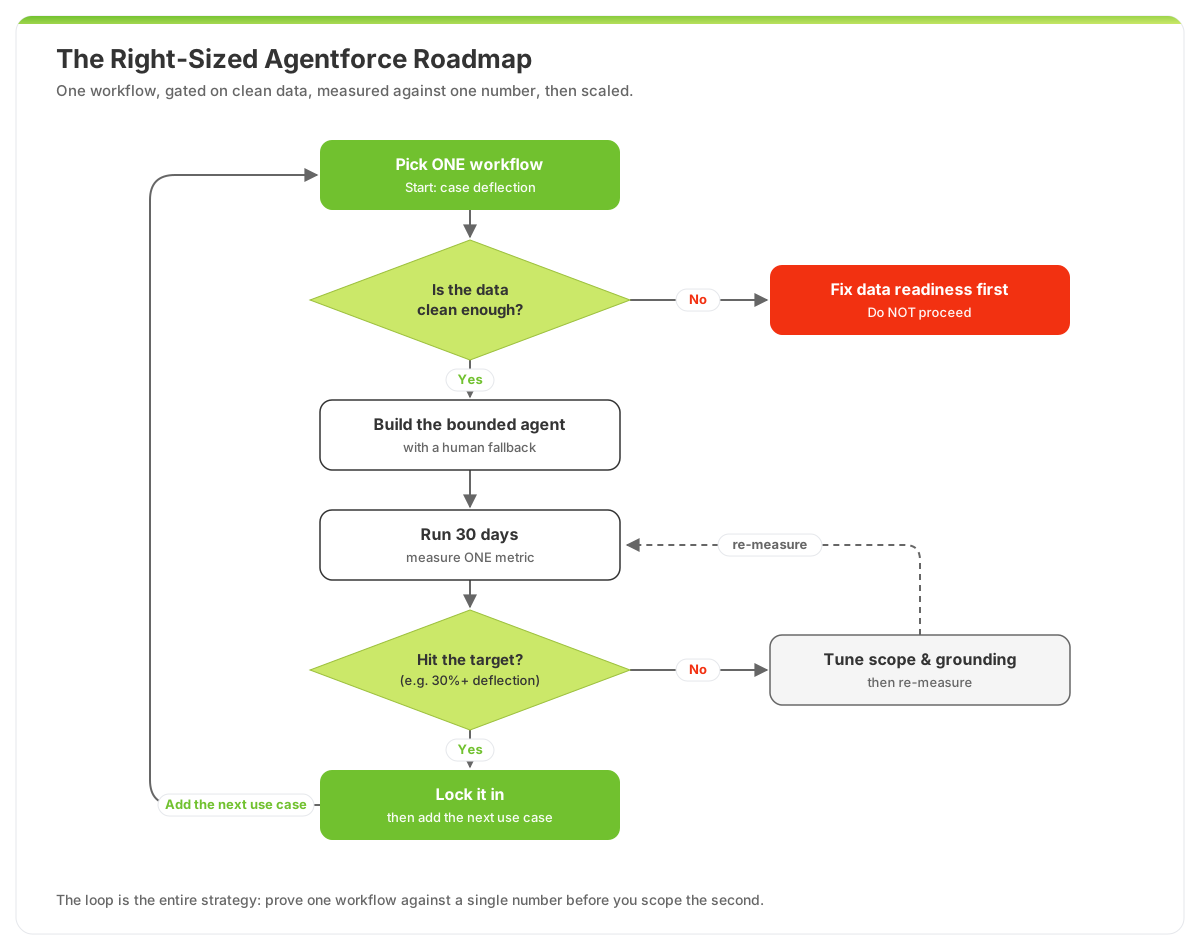 The right-sized roadmap loop: prove one bounded workflow against a single metric before scoping the next.
That loop is the entire strategy. One workflow, gated on clean data, measured against a single number, scaled only after it proves out. It's unglamorous, and that's precisely why it works while the moonshots stall.
Right-Sized vs. the Moonshot
| Approach | Scope | Time to value | Risk | Typical outcome |
|---|---|---|---|---|
| Right-sized (ODS) | 1 workflow, human fallback | 30-60 days | Low, recoverable | Measurable deflection or conversion lift |
| Enterprise "digital workforce" | 5-10 autonomous agents | 6-12+ months | High, public-facing errors | Stalled rollout, blown budget, eroded trust |
The right-hand column isn't a strawman. It's the cleanup project I get hired for after someone sold a 50-person company a 500-person vision.
✅ Key Takeaways
- The Agentforce use cases for small business that pay off are narrow: case deflection, lead qualification, meeting prep, in that order.
- Treat an agent as one bounded task, never a "digital employee." Your SMB edge is focus; don't dilute it across ten weak agents.
- Gate every use case on data readiness. A dirty CRM produces a confidently wrong agent.
- Measure one metric for 30 days before scaling. No proof, no second use case.
- Ignore vendor resolution-rate headlines. The only number that matters is your deflection on your tickets.
Frequently Asked Questions
What is the best first Agentforce use case for a small business?
Case deflection on tier-1 support. Your customers ask the same handful of questions constantly, the answers live in data you already have, and a human can catch any miss cheaply. It's the highest-volume, lowest-risk place to prove value, which is exactly why it should come before lead qualification or anything customer-facing and irreversible.
How much does it cost to run Agentforce at our size?
It depends on consumption, not seats. Agentforce bills against usage, so a narrow, well-scoped agent costs far less than a sprawling one. The real cost risk is scope creep. We break the model down in our CFO-ready guide to Agentforce pricing. Start with one metered workflow so your spend tracks a number you can defend.
Do we need Data Cloud or Data 360 before we start?
Usually not for a first, bounded use case, but the specific data that use case touches must be clean. Don't buy a data platform to fix a problem a focused cleanup solves. Run a data readiness audit scoped to the one workflow first, then decide whether a platform is even warranted.
How is Agentforce different from the chatbot we already have?
A scripted chatbot follows decision trees you hand-build. Agentforce reasons over your live Salesforce data and takes governed actions: updating a record, routing a lead, drafting a reply. That's more capable and higher-stakes, which is exactly why scope discipline and a human fallback matter more, not less.
How do we know if it's actually working?
Pick one metric before launch and watch it for 30 days: deflection rate for support, qualified-lead conversion for sales, time saved for meeting prep. If the number doesn't move, you tune the scope or kill it. "It felt smart in the demo" is not a result.
CTA: Start With One Agent That Pays for Itself
You don't need a digital workforce. You need one agent doing one job so well the ROI is impossible to argue with. Then a deliberate call on what comes next.
That's the entire premise of our Transformation package: we pick the single highest-impact Agentforce use case for your business, ground it in data we've verified is clean, ship it with a human fallback, and measure it against one number inside the 30-day milestone guarantee. No moonshots. No six-month "platform" detour.
Not sure your data is ready, or which workflow to start with? Begin with the free Salesforce audit. We'll tell you honestly whether you're agent-ready or whether a focused cleanup comes first. Want the math before you talk to anyone? Run the numbers in our ROI calculator, or get in touch and we'll scope the first use case together.
The companies that win with Agentforce aren't the ones that attempted the most. They're the ones that shipped one thing that worked, and could prove it.

About the Author
Scott Ohlund
Certified Salesforce Architect with 13+ years of experience. Specialist in AI Agentforce, Data Cloud, and business automation solutions. As founder of Optimum Data Solutions, Scott helps SMB and mid-market teams cut Salesforce tech debt and ship AI-first CRM that actually moves revenue.
Ready to Transform Your Salesforce Experience?
Let's discuss your specific needs and create a customized solution that drives real results for your business.