The 2-Week, Near-Zero-Cost Agentforce Pilot: Prove It Before You Sign a Consumption Commit
TL;DR: Run an Agentforce pilot before buying by building one narrow agent against your own anonymized data in a free sandbox, instrumenting every action, and measuring real cost-per-resolution over two weeks. You walk into the contract with a metered number, not a vendor's slide. So the consumption commit becomes a spreadsheet decision instead of a gamble.
Here's the trap almost every SMB walks into with Agentforce. You watch a polished demo. You believe Salesforce's 80% resolution stat. You sign a consumption commitment to lock in a discount. Then real traffic hits, the agent burns actions on edge cases nobody scoped, and your "AI savings" project quietly becomes the line item your CFO circles in red.
You can skip all of that. An Agentforce pilot before buying costs about an afternoon of setup, runs for two weeks against your real data, and produces the one number that makes or breaks the deal: what a resolution actually costs on your org, not on Salesforce's reference customer.
The reframe: you're not testing the AI, you're metering it
This is the part most people miss. When teams pilot Agentforce, they ask "does it work?" Wrong question. Of course it works. The models are good, the demos are real. The 80% resolution rate Salesforce quotes is genuine ; it's also completely useless to you in isolation, because it says nothing about your data, your edge cases, or your unit economics.
The real deliverable of a pilot isn't a thumbs-up. It's a calibrated cost-per-resolution figure derived from your own historical traffic. That single number turns a consumption contract from a leap of faith into arithmetic. You stop negotiating against the fear of the unknown and start negotiating against a measured baseline.
Consumption pricing is exactly why this matters. Agentforce bills on usage: Flex Credits drawn down per action, with resolution-based models layered on top . If you don't know how many actions your typical request consumes, you don't know your bill. Signing first and learning later is how a fixed-scope problem turns into a runaway operating expense. If the pricing mechanics still feel like fog, read our CFO-ready breakdown of Agentforce pricing before you do anything else.
How do you run an Agentforce pilot before buying?
You scope one narrow, high-volume use case, load real anonymized data into a free sandbox, build a single-topic agent, instrument every action, then replay 50–100 real historical requests to produce a cost-per-resolution number. All before you sign.
The whole method fits in one diagram. Note where the measurement happens: before the contract, not after.
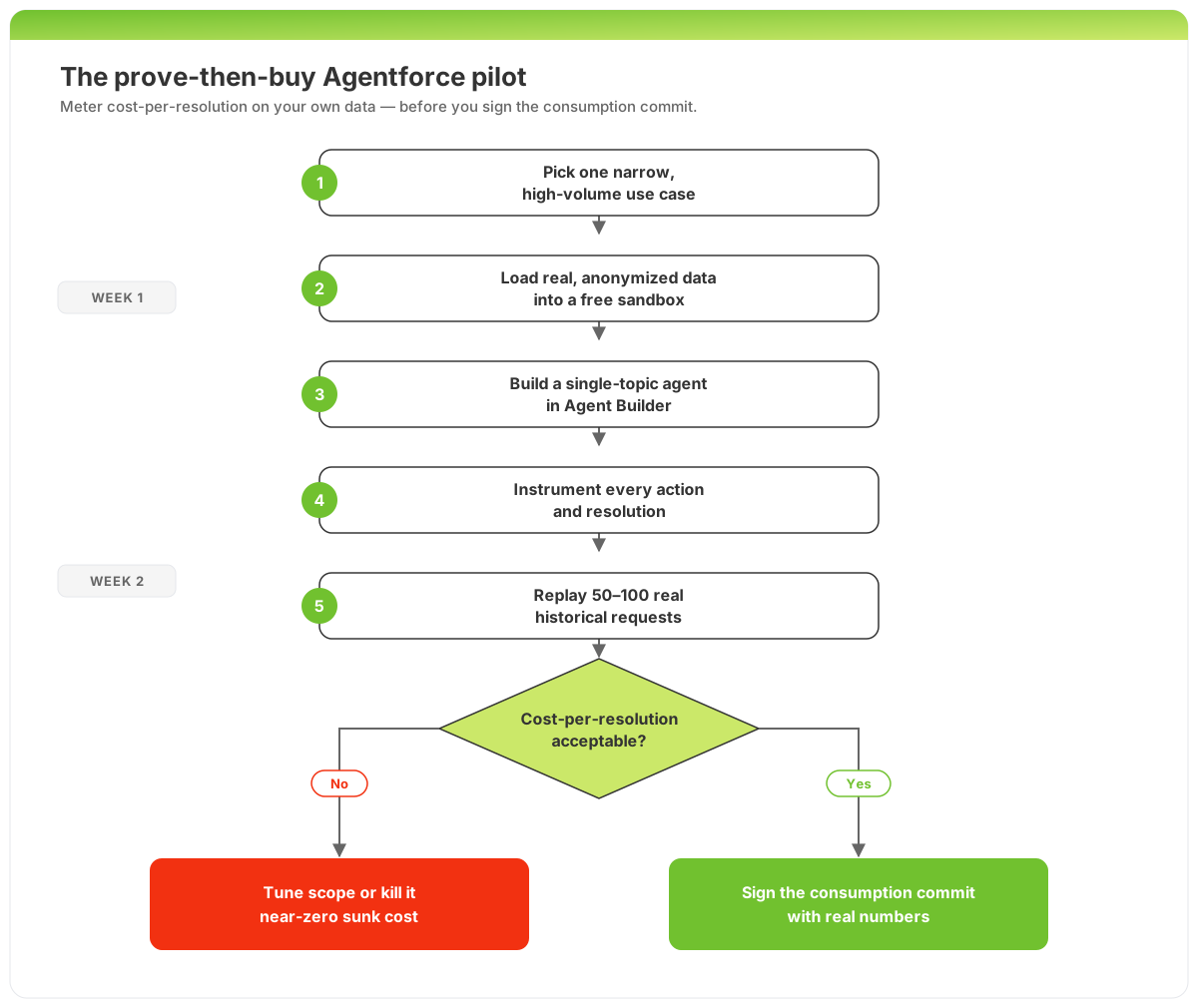 The prove-then-buy pilot: meter cost-per-resolution on your own data, then sign, or walk away after only an afternoon of sunk cost.
Week 1: scope narrow, load real, build small
Pick one use case with real volume. Not a moonshot. A returns-status question. An order lookup. A tier-1 support deflection. The Agentforce use cases that actually work for a 50-person company are narrow and high-frequency on purpose. They generate enough pilot traffic to produce a statistically honest number in two weeks.
Load real data (anonymized) into a sandbox or Developer Edition. This is non-negotiable, and it's where most "pilots" cheat. A demo on Salesforce's sample data proves nothing. Your data has the messy fields, the duplicate accounts, and the half-filled records that make agents stumble and burn extra actions. A pilot on clean fake data will lie to you. If your data isn't ready for this, the pilot will tell you fast, which is itself a valuable result. See why AI agent projects fail on data readiness.
Build a single-topic agent. One topic, a handful of actions, tight instructions. You can stand this up in an afternoon in Agent Builder. Resist every urge to add a second topic. Scope creep is what turns a two-week pilot into a two-month project.
Week 2: instrument, replay, measure
Now the part that separates a real pilot from a sales demo: instrument it. Before you run a single query, decide what you're capturing.
| Metric | What it tells you | Why it drives the contract |
|---|---|---|
| Actions per request | How "expensive" each interaction is | Directly sets your credit burn rate |
| Resolution rate (on your data) | % handled with no human handoff | Separates real deflection from theater |
| Cost per resolution | Actions × credit price ÷ resolutions | The single number you negotiate against |
| Escalation triggers | Where it gives up or guesses | Reveals data gaps and scope to trim |
| Confident-but-wrong rate | How often it's wrong and sure | Your governance and risk exposure |
Then replay 50 to 100 real historical requests. Pull last month's actual support tickets or order questions and feed them through. You're not inventing scenarios; you're re-running reality. The output is a distribution, not a vibe: median actions per resolution, the long tail of expensive edge cases, and a defensible cost-per-resolution you can multiply by your monthly volume.
That projected monthly number is what you carry into the negotiation. Plug it into our ROI calculator to model breakeven against the consumption commit you're being offered. If the math works, sign with confidence. If it doesn't, you've spent an afternoon instead of a quarter's budget.
What does "near-zero cost" actually mean for an Agentforce pilot?
Near-zero cost means the only meaningful expense is labor, roughly 8–12 hours of one builder's time, because the sandbox or Developer Edition is free and pilot-scale usage runs to single or low-double-digit dollars.
Let's be precise, because "free pilot" is exactly the kind of claim I'd push back on if a vendor said it to me.
- Sandbox / Developer Edition: included with your Salesforce license or free. No new spend.
- Agentforce usage in the pilot: small. You're running ~100 requests, not production traffic. Flex Credits for a scoped two-week test are trivial: single or low-double-digit dollars, not a commitment .
- Labor: the real cost. One competent builder, roughly 8–12 hours across two weeks .
Compare that to the alternative (buy first, discover later), and the asymmetry is the whole argument:
| Prove-then-buy pilot | Buy-then-discover | |
|---|---|---|
| Cash at risk before proof | ~An afternoon of labor | A signed consumption commit |
| When you learn your real cost-per-resolution | Before signing | On your first true-up invoice |
| Downside if it fails | Sunk afternoon | Locked-in spend on an underperforming agent |
| Negotiating position | Armed with your own numbers | Anchored to the vendor's slide |
What failure modes does an Agentforce pilot prevent?
It catches two expensive failure modes before you sign: consumption spikes from long-tail edge cases, and agents that are confidently wrong.
Blindsided by consumption spikes. When you've metered actions-per-request on messy real data, the long-tail edge cases that blow up bills show up in the pilot, where they cost nothing. You scope them out, or you budget for them deliberately. No surprise true-up.
Confidently wrong agents. The instrumentation captures whether the agent resolved a request, and also whether it was wrong and sure of itself, the failure mode that quietly erodes customer trust. That's a governance signal you want before launch, not after a customer screenshots a bad answer. Pair this with the Einstein Trust Layer governance checklist your board will eventually ask for.
✅ Key Takeaways
- A pilot's real output isn't "it works." It's a cost-per-resolution number on your own data.
- Instrument before you run. If you can't measure actions-per-request, you can't predict your bill.
- Use real, anonymized data. Clean sample data hides the edge cases that cause consumption spikes.
- Scope to one narrow, high-volume use case so two weeks produces an honest distribution.
- Walk into the consumption commit with your own numbers. The contract becomes arithmetic, not a gamble.
Frequently Asked Questions
How long does an Agentforce pilot before buying really take?
About two weeks of calendar time and 8–12 hours of actual build work. Week one is scoping one use case, loading anonymized real data, and building a single-topic agent. Week two is instrumentation and replaying 50–100 historical requests to produce your cost-per-resolution figure. The clock is short because the scope is deliberately narrow.
Can I run the pilot without paying Salesforce anything?
Almost. A sandbox or Developer Edition is free or included with your license, and pilot-scale usage of ~100 requests consumes only minor credits, not a commitment. The meaningful cost is labor, not software. That's the entire point: you risk an afternoon, not a contract.
Why can't I just trust Salesforce's 80% resolution rate?
Because that number describes someone else's data, not yours. The figure is real, but resolution rate without your cost-per-resolution and your edge-case distribution tells you nothing about your bill or your risk. The pilot exists to translate a generic benchmark into your specific unit economics.
What if the pilot shows the agent isn't worth it?
Then it just saved you a quarter's budget. A failed pilot costs an afternoon; a failed production rollout costs a signed consumption commit plus the cleanup. A "no" backed by your own instrumented data is one of the most valuable outcomes this method produces. And it's usually a data-readiness problem you can fix and re-pilot.
Do I need a consultant, or can my admin run this?
A strong admin can build the agent. The part that needs experience is the instrumentation and the math: defining what to measure, replaying real traffic honestly, and turning the distribution into a defensible negotiating number. That's the difference between a demo and a pilot, and it's where ODS does its highest-leverage work.
CTA: Get your cost-per-resolution number before the sales call, not after
You don't need Salesforce's permission to find out what an agent will cost you. You need two weeks, real data, and someone who knows what to instrument. That's exactly the prove-then-buy pilot ODS runs as the on-ramp to our Transformation package: we build the narrow agent, meter it against your own traffic, and hand you the cost-per-resolution number you'll use to negotiate the commit.
Not sure your data is even ready to pilot? Start with a free Salesforce audit. We'll flag the gaps that would blow up your action counts before you spend a dollar. Or run the numbers yourself in our ROI calculator, then talk to us about standing up the pilot. Prove it first. Sign second. That order is the whole strategy.

About the Author
Scott Ohlund
Certified Salesforce Architect with 13+ years of experience. Specialist in AI Agentforce, Data Cloud, and business automation solutions. As founder of Optimum Data Solutions, Scott helps SMB and mid-market teams cut Salesforce tech debt and ship AI-first CRM that actually moves revenue.
Ready to Transform Your Salesforce Experience?
Let's discuss your specific needs and create a customized solution that drives real results for your business.